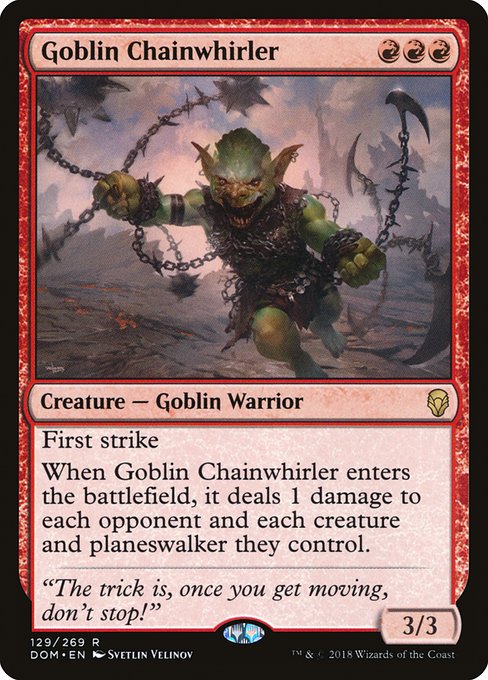
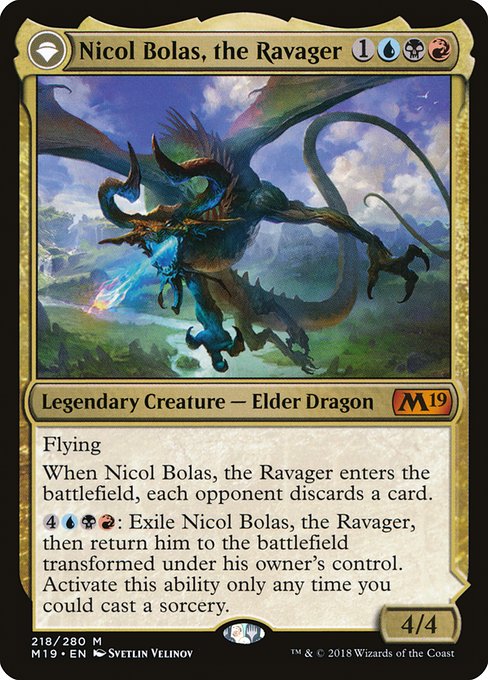
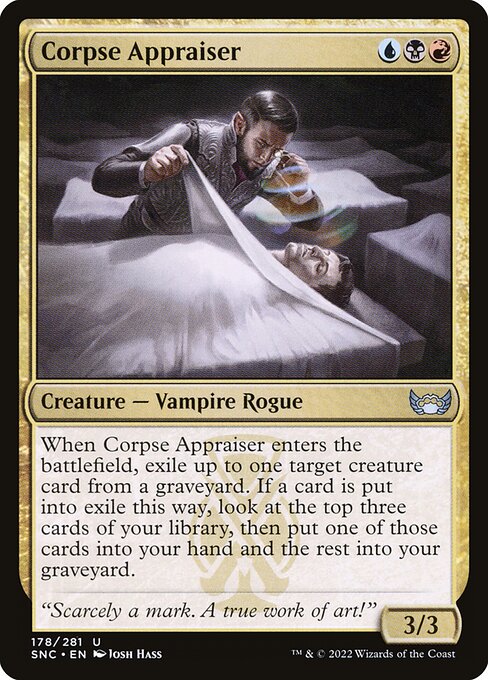
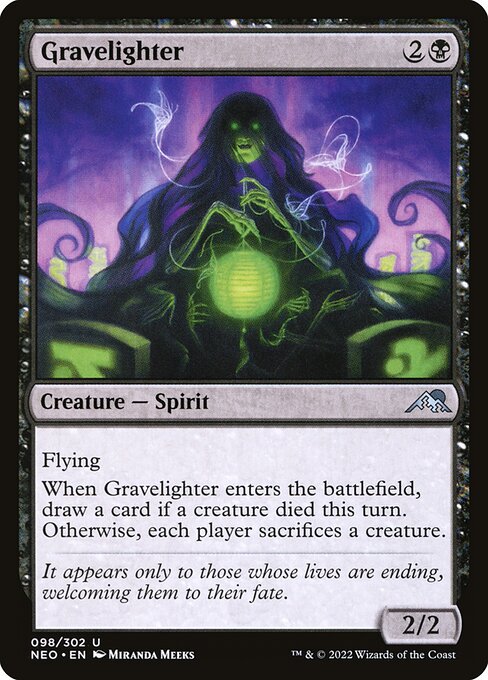
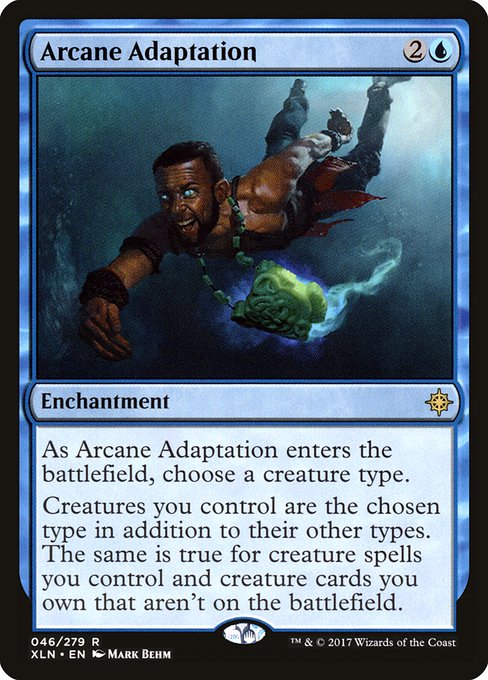
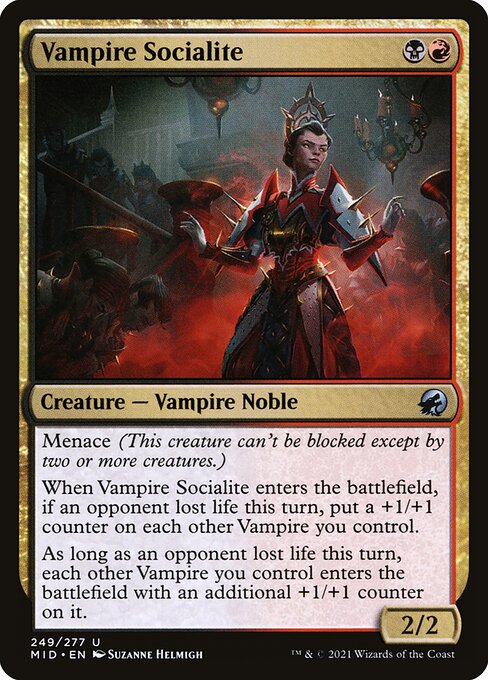
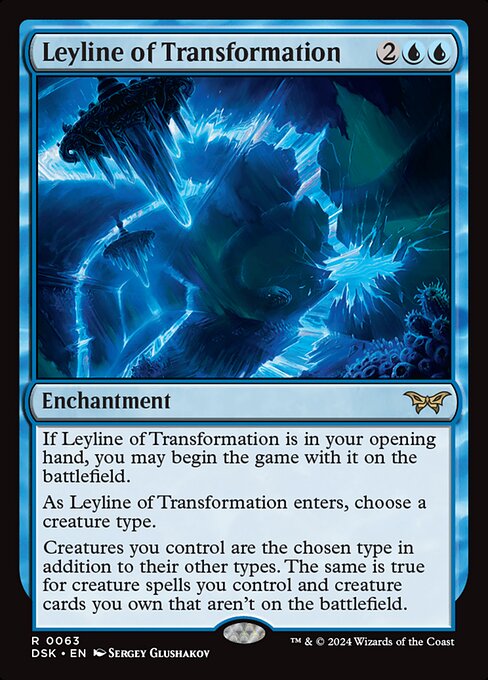
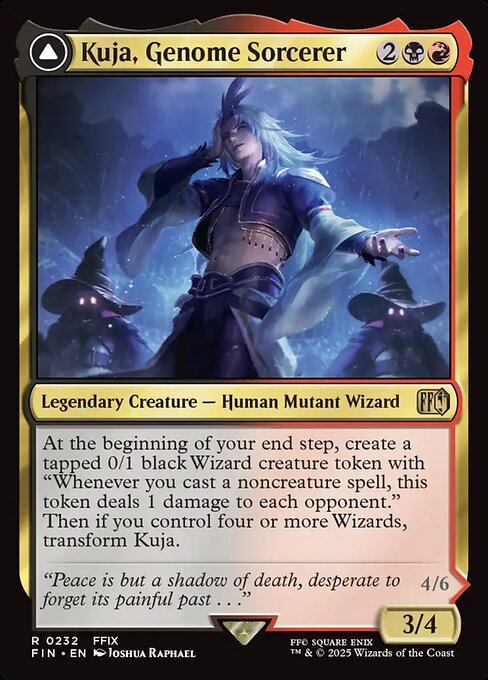
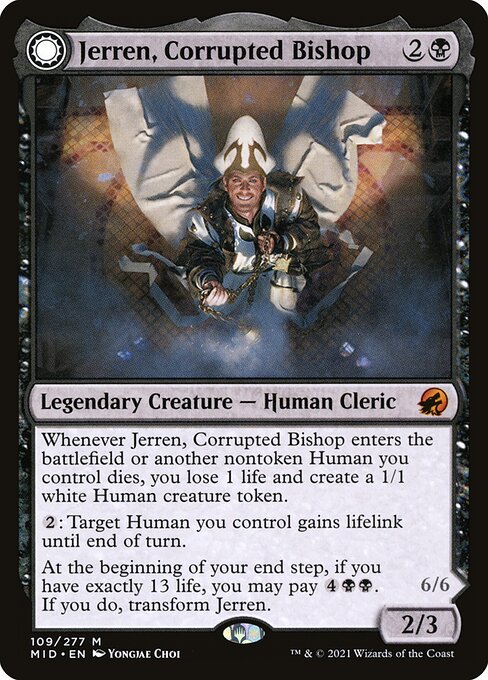
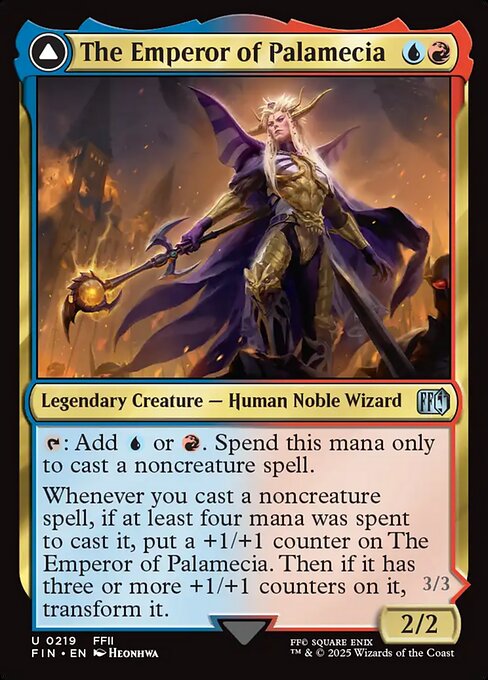
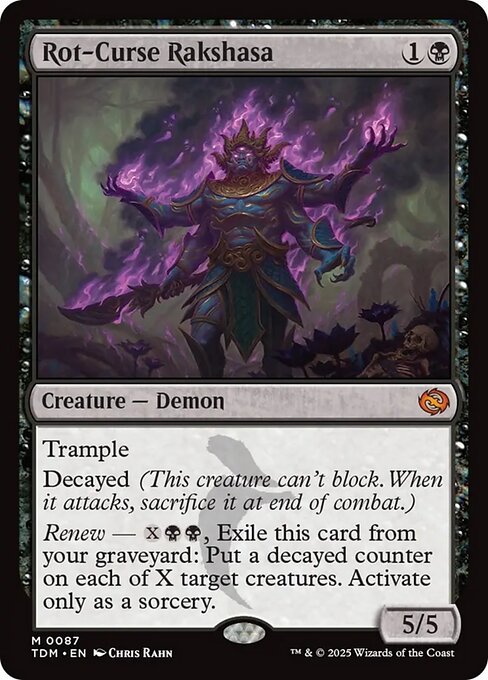
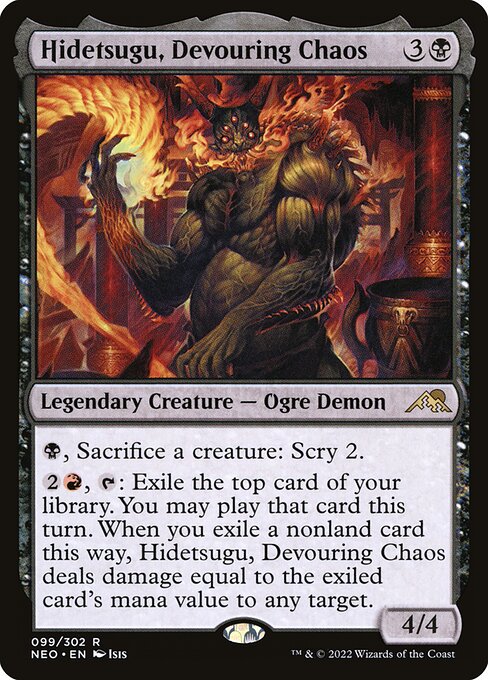
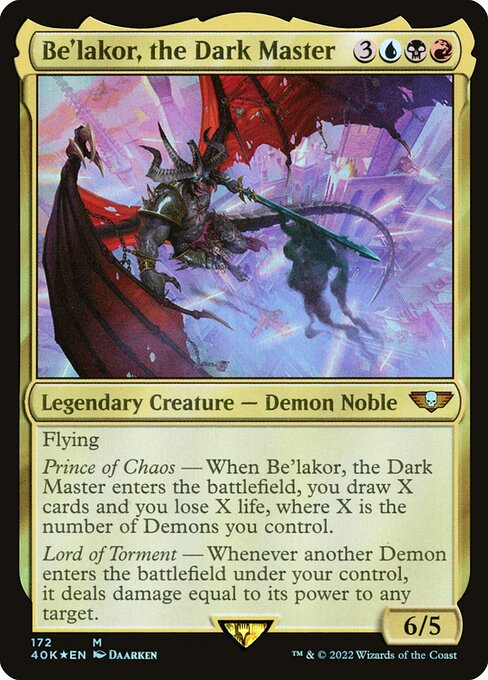
Be'lakor wants a deck that plays sturdy creatures that also deal with opponents' cards. It also suits a deck that is built around one creature type, like Elves or Dragons.
Mana cost
Blue, Black, Red ()
Power / toughness6 / 5
RarityMythic
Flying
Prince of Chaos — When Be'lakor enters, you draw X cards and you lose X life, where X is the number of Demons you control.
Lord of Torment — Whenever another Demon you control enters, it deals damage equal to its power to any target.
Picked for what they do in Be'lakor's deck. When two cards do the same job, the one with the lower comes first. All of them fit Be'lakor's color identity.Mana ValueThe total amount of mana a card costs, all added up. A card costing two generic and one green has a mana value of three. Wizards renamed this from "converted mana cost" in 2021, so older cards and articles may still use the old name.Open the full glossary
explain how Be'lakor works in tricky situations. They come from Wizards of the Coast, the company that makes Magic.RulingThe official answer to how a card works in a tricky situation. Most rulings are written by Wizards of the Coast, the company that makes Magic, and a few are notes from Scryfall, the card database Magic players use. A ruling explains a card. It does not change what the card says.Open the full glossary
Wizards of the Coast7 Oct 2022
The number of Demons you control is counted only as Be'lakor, the Dark Master's ability resolves. If Be'lakor is still on the battlefield, it will count itself.
Color identityEvery color of mana symbol on a card, in its cost and in its rules text. Your commander's color identity sets the limit for your whole deck: every other card has to fit inside it. A deck led by a green and white commander cannot play a card with any blue in its color identity.Open the full glossaryUBRPlayers write colors as letters: U for blue, B for black, R for red. Blue is U because B was already taken by black.MidrangeMidrange decks play solid creatures that also deal with opponents' cards, attacking when it is safe and defending when it is not. They sit in the middle: slower than an all-out attacking deck, sturdier than a deck built to answer everything.Open the Midrange pageValue CreatureA creature that does two jobs: it deals with an opponent's card when it arrives, then stays as a real attacker. Its enter the battlefield ability destroys, damages, counters or bounces something, and it has 3 or more power or an ability like flying that makes it hard to block. Answering your opponent and pressuring them with the same card is what a Midrange deck is built on. Shriekmaw, Meteor GolemOpen the Value Creature pageDamage RemovalRemoves creatures by dealing damage to them rather than by destroying them outright. This includes fight cards, where your creature deals the damage. Damage only kills a creature if it at least equals its toughness, so it can miss the biggest ones, and it does not kill a creature that cannot be destroyed. Lightning Bolt, Rabid Bite, PyroclasmOpen the Damage Removal pageETB ValueDoes something useful the moment it arrives: an enter the battlefield ability, which players shorten to ETB. You keep that effect even if the card is removed straight afterwards, which is why these pair so well with flicker cards that make them enter again. Solemn Simulacrum, The One RingOpen the ETB Value pageTypal PayoffRewards you for playing lots of one kind of creature. That includes "lords" that make every other Goblin or Merfolk you control bigger, and cards that ask you to choose a creature type and then pay you off for it. A creature type is the word on the middle line of the card, like Goblin, Elf or Zombie.Open the Typal Payoff pageTypal/KindredTypal decks are built around one creature type, like Elves, Dragons or Zombies, with cards that make that type stronger. The type is printed after the dash on the card's type line, and the strategy is also called kindred or tribal.Open the Typal/Kindred pageEvasionAn ability that makes a creature hard to block, so its attacks reach the player. Flying, menace, landwalk and plain 'can't be blocked' are the common kinds.Open the Evasion pageBurnBurn decks win by dealing damage straight to opponents with spells and abilities, rather than by attacking with creatures. Damage that hits every opponent at once counts three times over at a four-player table.Open the Burn pageBurnDeals damage directly, to creatures or to players. Because it can hit a player as easily as a creature, the same card can remove a blocker or finish off an opponent. Lightning Bolt, Blasphemous ActOpen the Burn pageDemonsDemons are almost all black, and about half of them fly. Some are large but ask you to pay a price, such as sacrificing another creature.Open the Demons pageDrawDraws you extra cards. More cards means more choices every turn, and in a 100-card deck it is the main way to find the pieces you need. Rhystic Study, SkullclampOpen the Draw page
Send Us Feedback
What works, what's confusing, what you wish the site did. We read every one.
Not signed in? That is fine. We only keep what you write.
Optional. We only use it to reply to you.
Can we use Google Analytics cookies?
They show us which pages help people. No ads.
Privacy Policy


 Open the full glossary