- Commander Nexus
- Commanders
- Eirdu, Carrier of Dawn // Isilu, Carrier of Twilight
Command zone
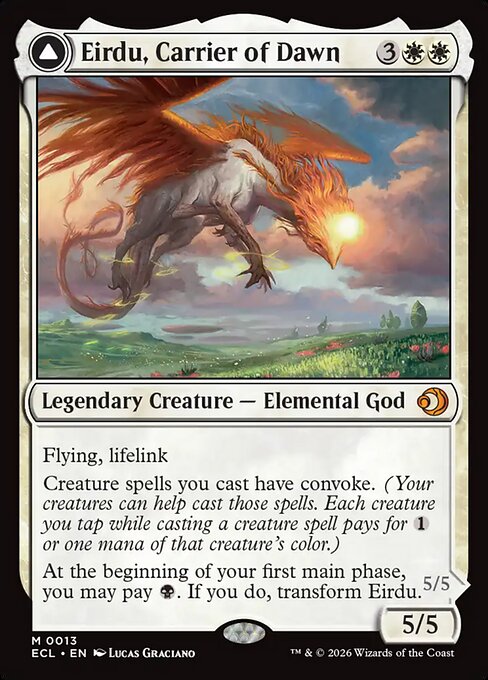
Eirdu, Carrier of Dawn // Isilu, Carrier of Twilight
Legendary Creature — Elemental God // Legendary Creature — Elemental God
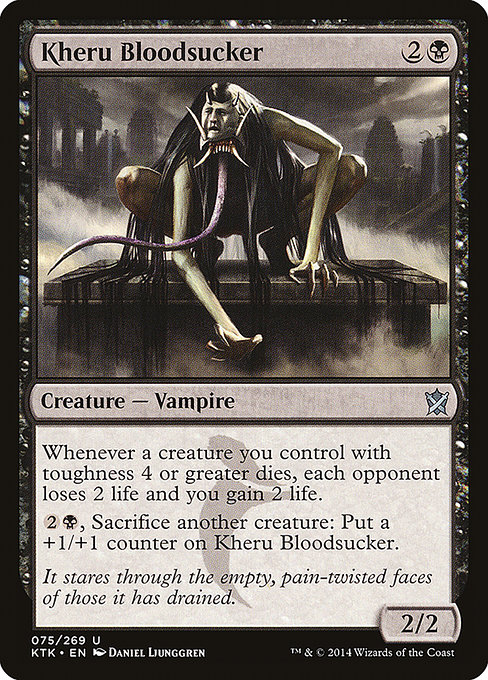
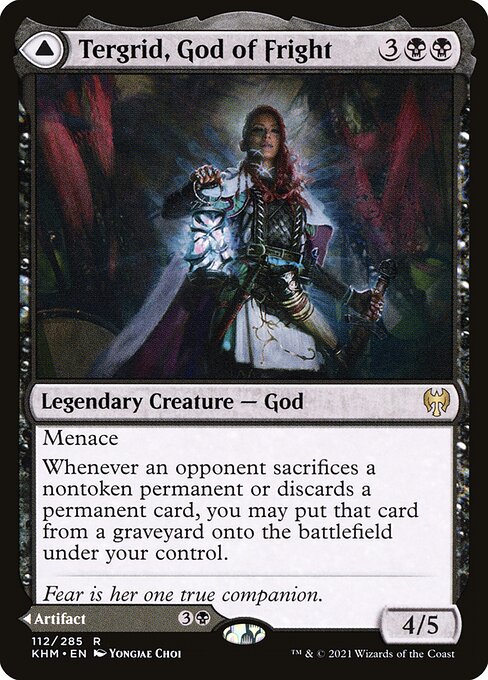
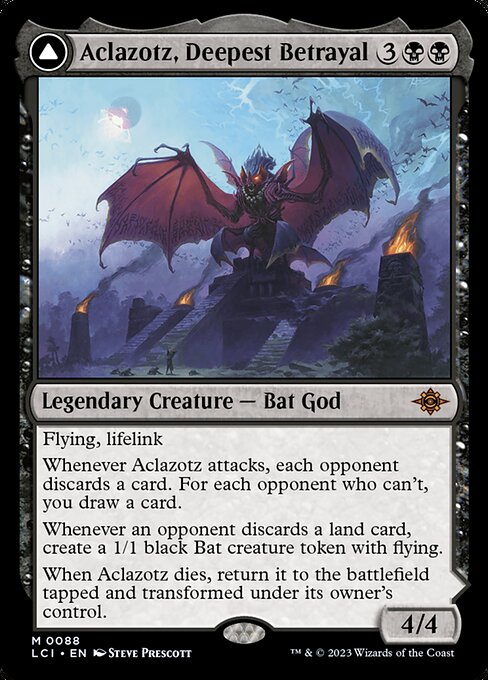
Eirdu wants a deck that is built around one creature type, like Elves or Dragons. It also suits a deck that sacrifices its own creatures to drain opponents' life.
- Mana cost


- White, Black ()
- Power / toughness5 / 5
- RarityMythic
Flying, lifelink
Creature spells you cast have convoke. (Your creatures can help cast those spells. Each creature you tap while casting a creature spell pays for  or one mana of that creature's color.)
At the beginning of your first main phase, you may pay  . If you do, transform Eirdu.
//
Flying, lifelink
Each other nontoken creature you control has persist. (When it dies, if it had no -1/-1 counters on it, return it to the battlefield under its owner's control with a -1/-1 counter on it.)
At the beginning of your first main phase, you may pay . If you do, transform Isilu.
Build a deck with Eirdu Find it in the app
- Archetypes
- Themes
Cards That Fit Eirdu, Carrier of Dawn
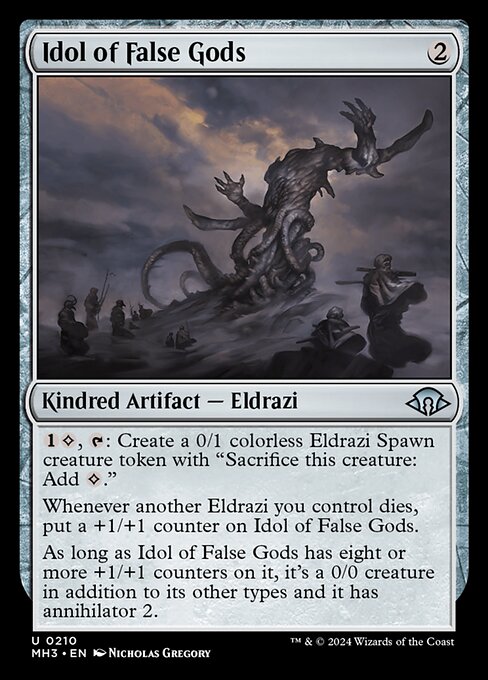
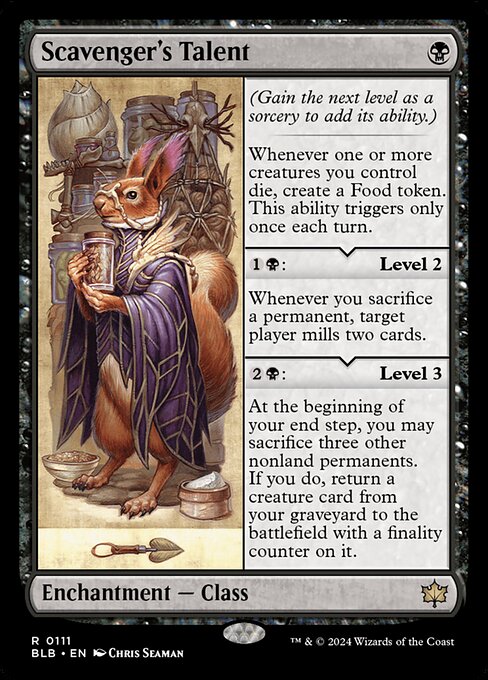
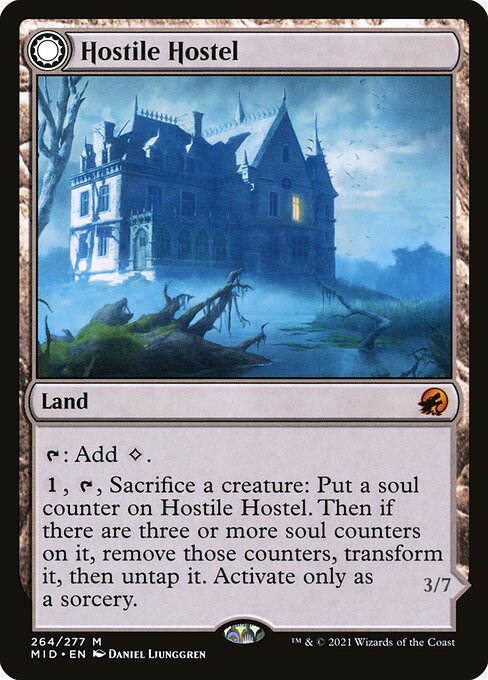
Picked for what they do in Eirdu's deck. When two cards do the same job, the one with the lower comes first. All of them fit Eirdu's color identity.Mana ValueThe total amount of mana a card costs, all added up. A card costing two generic and one green has a mana value of three. Wizards renamed this from "converted mana cost" in 2021, so older cards and articles may still use the old name. Open the full glossary
plan6



plan6







Rulings for Eirdu, Carrier of Dawn
explain how Eirdu works in tricky situations. They come from Wizards of the Coast, the company that makes Magic.RulingThe official answer to how a card works in a tricky situation. Most rulings are written by Wizards of the Coast, the company that makes Magic, and a few are notes from Scryfall, the card database Magic players use. A ruling explains a card. It does not change what the card says.Open the full glossary
A nonmodal double-faced card enters with its front face up by default, unless a spell or ability instructs you to put it onto the battlefield transformed or allows you to cast it transformed, in which case it enters with its back face up.
A token that is created as a copy of a double-faced permanent or a double-faced card in another zone is a double-faced token. It will have both the front face and back face of whatever object it's copying. If it's copying a double-faced permanent whose back face is up, the token will enter with its back face up. It can transform if instructed to do so.
Each face of a nonmodal double-faced card has its own set of characteristics: name, types, subtypes, abilities, and so on. While a double-faced permanent is on the battlefield, consider only the characteristics of the face that's currently up. The other set of characteristics is ignored.
Each nonmodal double-faced card in this release is cast face up. In every zone other than the battlefield, consider only the characteristics of its front face. If it is on the battlefield, consider only the characteristics of the face that's up; the other face's characteristics are ignored.
If a card with persist is removed from the graveyard after it dies but before the triggered ability resolves, it won't be returned to the battlefield.
If a creature has +1/+1 counters and -1/-1 counters on it, state-based actions remove the same number of each so that it has only one kind of those counters on it. A creature's persist ability can bring it back again if its -1/-1 counters are removed this way.
If a creature with persist that has +1/+1 counters on it receives enough -1/-1 counters to cause it to be destroyed by lethal damage or put into its owner's graveyard for having 0 or less toughness, persist won't trigger and the card won't return to the battlefield. That's because persist checks the creature as it last existed on the battlefield, and it still had -1/-1 counters on it at that point.
If a creature you control has a mana ability with {T} in the cost, activating that ability while casting a spell with convoke will result in the creature being tapped before you pay the spell's costs. You won't be able to tap it again for convoke. Similarly, if you sacrifice a creature to activate a mana ability while casting a spell with convoke, that creature won't be on the battlefield when you pay the spell's costs, so you won't be able to tap it for convoke.
If you are instructed to put a card that isn't a double-faced card onto the battlefield transformed, it will not enter at all.
If you sacrifice Eirdu while casting a creature spell (to activate a mana ability, for example), the spell won't have convoke when you pay its costs unless it has convoke some other way.
In some rare cases, this permanent might transform while its triggered ability that allows you to pay mana to transform it is still on the stack. (For example, another effect might cause that ability to trigger an additional time.) In such a case, even if you pay mana as the triggered ability resolves, this permanent won't transform because it already transformed while the triggered ability was on the stack.
In the Commander variant, a double-faced card's color identity is determined by the mana costs and mana symbols in the rules text of both faces combined. If either face has a color indicator or basic land type, those are also considered. For example, Oko, Lorwyn Liege's color identity is green and blue, since its front face is blue, its rules text contains a green mana symbol, and its back face has a green color indicator as well as a blue mana symbol in its rules text.
Once persist returns the creature, it's considered a new object with no relation to the object that it was. Auras that were attached to it won't return to the battlefield. Equipment that was attached to it will remain unattached. Any counters that were on it won't be put on the new creature.
Tapping an untapped creature that's attacking or blocking to convoke a spell won't cause that creature to stop attacking or blocking.
The back face of a nonmodal double-faced card usually has a color indicator that defines its color.
The mana value of a nonmodal double-faced card is the mana value of its front face, no matter which face is up.
When calculating a spell's total cost, include any alternative costs, additional costs, or anything else that increases or reduces the cost to cast the spell. Convoke applies after the total cost is calculated. Convoke doesn't change a spell's mana cost or mana value.
You can tap any untapped creature you control to convoke a spell, even one you haven't controlled continuously since the beginning of your most recent turn.
18 rulings, all written by Wizards of the Coast. Read the originals on Gatherer ↗
Similar Commanders
Commanders that share the most with Eirdu, and what they share.


