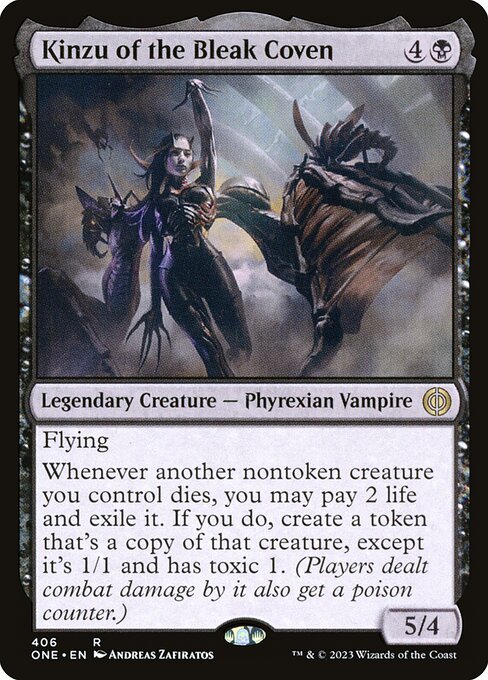
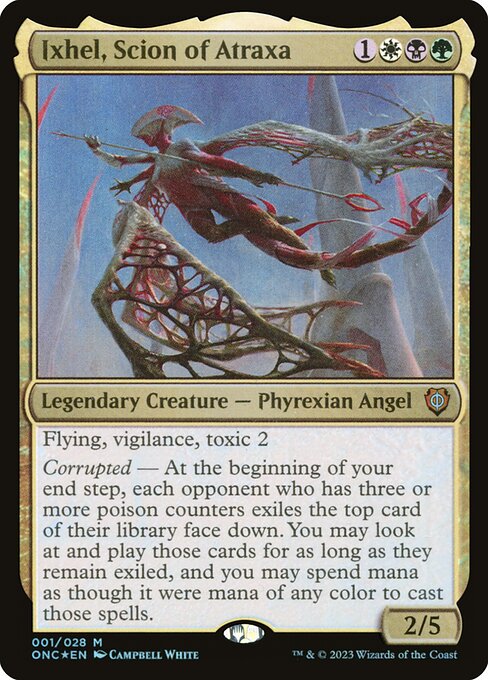
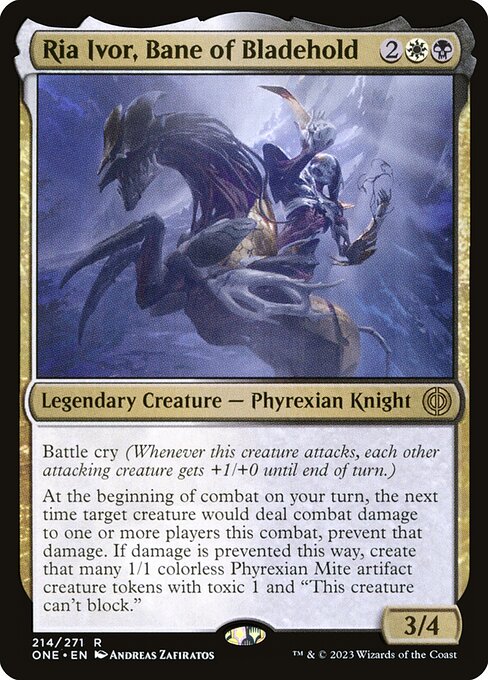
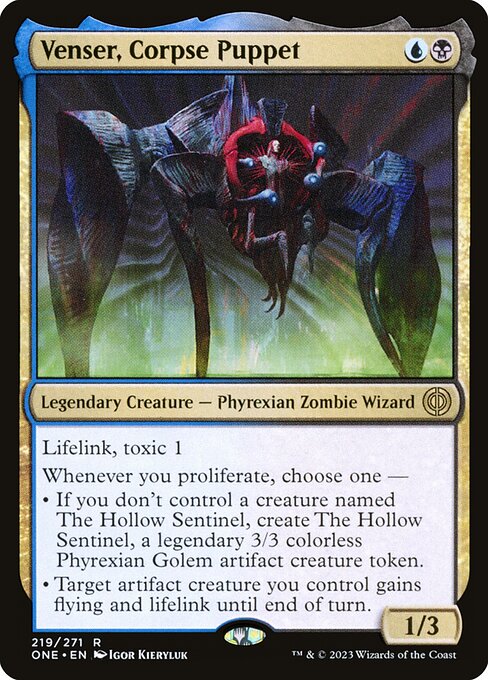
Karumonix wants a deck that wins with poison counters instead of damage. It also suits a deck that is built around one creature type, like Elves or Dragons.
Mana cost
Black ()
Power / toughness3 / 3
RarityRare
Toxic 1 (Players dealt combat damage by this creature also get a poison counter.)
Other Rats you control have toxic 1.
When Karumonix enters, look at the top five cards of your library. You may reveal any number of Rat cards from among them and put the revealed cards into your hand. Put the rest on the bottom of your library in a random order.
Picked for what they do in Karumonix's deck. When two cards do the same job, the one with the lower comes first. All of them fit Karumonix's color identity.Mana ValueThe total amount of mana a card costs, all added up. A card costing two generic and one green has a mana value of three. Wizards renamed this from "converted mana cost" in 2021, so older cards and articles may still use the old name.Open the full glossary
explain how Karumonix works in tricky situations. They come from Wizards of the Coast, the company that makes Magic.RulingThe official answer to how a card works in a tricky situation. Most rulings are written by Wizards of the Coast, the company that makes Magic, and a few are notes from Scryfall, the card database Magic players use. A ruling explains a card. It does not change what the card says.Open the full glossary
Wizards of the Coast4 Feb 2023
A player with ten or more poison counters loses the game. This is a state-based action and doesn't use the stack. In other words, it happens immediately and players can't respond to it, just like a player losing the game due to having 0 or less life.
Wizards of the Coast4 Feb 2023
Any other effects of that damage, such as life gain from lifelink, still apply.
Wizards of the Coast4 Feb 2023
Conversely, replacement effects that apply to the number of counters put on a player can modify the counters placed this way. For example, Vorinclex, Monstrous Raider's last two abilities can apply to counters placed this way.
Wizards of the Coast4 Feb 2023
Damage dealt by a creature with toxic grants the same number of counters regardless of how much damage is dealt. Notably, if a replacement effect modifies the damage in some way (such as that of Gratuitous Violence), the number of counters given remains unchanged.
Wizards of the Coast4 Feb 2023
If a creature with toxic deals combat damage to a creature or planeswalker, or if it deals noncombat damage, toxic has no effect and no player gets poison counters.
Wizards of the Coast4 Feb 2023
Multiple instances of toxic are cumulative. For example, if a creature has toxic 2 and gains toxic 1 due to another effect, combat damage that creature deals to a player will cause that player to get 3 poison counters.
Wizards of the Coast4 Feb 2023
Toxic doesn't change the amount of combat damage a creature deals. For example, if a 2/2 creature with toxic 1 deals combat damage to a player, that creature will deal 2 damage. The results of that damage are the player loses 2 life and gets a poison counter.
Color identityEvery color of mana symbol on a card, in its cost and in its rules text. Your commander's color identity sets the limit for your whole deck: every other card has to fit inside it. A deck led by a green and white commander cannot play a card with any blue in its color identity.Open the full glossaryBPlayers write colors as letters: B for black.Infect/ToxicInfect and toxic decks win with poison counters instead of damage: a player with ten or more poison counters loses the game. Creatures with infect give players poison counters instead of normal damage, and creatures with toxic give poison counters on top of their combat damage.Open the Infect/Toxic pagePoisonGives out poison counters, or gets stronger when opponents have them. A player who has ten or more poison counters loses the game. Cards with the keyword infect or toxic hand out poison counters when they deal damage to a player.Open the Poison pageETB ValueDoes something useful the moment it arrives: an enter the battlefield ability, which players shorten to ETB. You keep that effect even if the card is removed straight afterwards, which is why these pair so well with flicker cards that make them enter again. Solemn Simulacrum, The One RingOpen the ETB Value pageTypal/KindredTypal decks are built around one creature type, like Elves, Dragons or Zombies, with cards that make that type stronger. The type is printed after the dash on the card's type line, and the strategy is also called kindred or tribal.Open the Typal/Kindred pageTypal PayoffRewards you for playing lots of one kind of creature. That includes "lords" that make every other Goblin or Merfolk you control bigger, and cards that ask you to choose a creature type and then pay you off for it. A creature type is the word on the middle line of the card, like Goblin, Elf or Zombie.Open the Typal Payoff pageCard SelectionImproves what you draw rather than how much: you look at the top few cards of your library and decide what stays on top. Ponder lets you rearrange the top three, Serum Visions lets you scry, and Consider lets you surveil. It makes your draws more reliable without giving you extra cards.Open the Card Selection pageLibrary ManipulationCards that let you look at, rearrange or play from the top of your deck, so you control what you draw next.Open the Library Manipulation pageRatsRats are almost all black creatures. A few, like Relentless Rats, say a deck can have any number of copies, which breaks Commander's usual singleton rule of one copy per card.Open the Rats pageDrawDraws you extra cards. More cards means more choices every turn, and in a 100-card deck it is the main way to find the pieces you need. Rhystic Study, SkullclampOpen the Draw page
Send Us Feedback
What works, what's confusing, what you wish the site did. We read every one.
Not signed in? That is fine. We only keep what you write.
Optional. We only use it to reply to you.
Can we use Google Analytics cookies?
They show us which pages help people. No ads.
Privacy Policy


 Open the full glossary