- Commander Nexus
- Commanders
- Umori, the Collector
Command zone
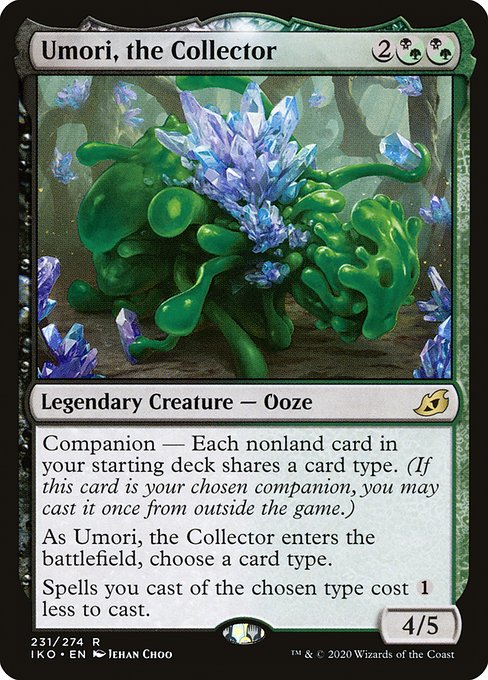
Umori, the Collector
Legendary Creature — Ooze
Umori wants a deck that is built around one creature type, like Elves or Dragons. It also works in a deck built around Oozes.
- Mana cost


- Black, Green ()
- Power / toughness4 / 5
- RarityRare
Companion — Each nonland card in your starting deck shares a card type. (If this card is your chosen companion, you may put it into your hand from outside the game for  as a sorcery.)
As Umori enters, choose a card type.
Spells you cast of the chosen type cost  less to cast.
Build a deck with Umori Find it in the app
- Archetypes
- Themes
-
- Oozes
Cards That Fit Umori, the Collector
Picked for what they do in Umori's deck. When two cards do the same job, the one with the lower comes first. All of them fit Umori's color identity.Mana ValueThe total amount of mana a card costs, all added up. A card costing two generic and one green has a mana value of three. Wizards renamed this from "converted mana cost" in 2021, so older cards and articles may still use the old name. Open the full glossary
plan6


Does what Umori, the Collector does6


Rulings for Umori, the Collector
explain how Umori works in tricky situations. They come from Wizards of the Coast, the company that makes Magic, and from Scryfall, the card database Magic players use.RulingThe official answer to how a card works in a tricky situation. Most rulings are written by Wizards of the Coast, the company that makes Magic, and a few are notes from Scryfall, the card database Magic players use. A ruling explains a card. It does not change what the card says.Open the full glossary
Artifact, creature, enchantment, instant, planeswalker, and sorcery are card types. Supertypes (such as legendary) and subtypes (such as Ooze) are not.
Before shuffling your deck to become your library, you may reveal one card from outside the game to be your companion if your starting deck meets the requirements of the companion ability. You can't reveal more than one. It remains revealed outside the game as the game begins.
Effects that reduce the generic mana cost of a spell (such as that of Umori) can't reduce that spell's colored mana requirements.
If more than one player wishes to reveal a companion, the starting player does so first, and players proceed in turn order. Once a player has chosen not to reveal a companion, that player can't change their mind.
If you reveal a companion outside the game, for as long as it remains there, you may pay {3} any time you could cast a sorcery (that is, you have priority during your main phase and the stack is empty). Once you do, you put it into your hand and behaves like any other card you've brought into the game. For example, if it's discard, countered, or destroyed, it's put into your graveyard, remaining in the game. This is a change from previous rules.
Land cards in your deck may have any number of additional types that may be shared with other cards or not.
Paying {3} to put your companion into your hand is a special action. It doesn't use the stack and players can't respond to it. Once you take this action, you may cast that card if it's legal to do so before any other player can take actions.
The companion ability has no effect if the card is in your starting deck and creates no restriction on putting a card with a companion ability into your starting deck. For example, Zirda may be in your starting deck even if your other permanent cards don't all have activated abilities.
The companion's other abilities apply only if the creature is on the battlefield. They have no effect while the companion is outside the game.
The requirements of the companion ability apply only to your starting deck. They do not apply to your sideboard.
To satisfy Umori's companion requirement, there must be one card type that each nonland card in your starting deck has. For example, if every nonland card is an artifact creature, enchantment creature, or creature, it is satisfied; but if you have an artifact creature, an artifact, and a creature, it is not satisfied.
You may have one companion in the Commander variant. Your deck, including your commander, must meet its companion requirement. Your companion is not one of your one hundred cards.
Your companion begins the game outside the game. In tournament play, this means your sideboard. In casual play, it's simply a card you own that's not in your starting deck.
If you reveal a companion outside the game, for as long as it remains there, you may pay {3} any time you could cast a sorcery (that is, you have priority during your main phase and the stack is empty). Once you do, you put it into your hand and behaves like any other card you've brought into the game. For example, if it's discarded, countered, or destroyed, it's put into your graveyard, remaining in the game. This is a change from previous rules.
Once you put your companion into your hand, it behaves like any other card you’ve brought into the game. For example, if it’s countered or destroyed, it’s put into your graveyard, remaining in the game.
Paying {3} to put your companion into your hand is a special action. It doesn't use the stack and players can't respond to it. Once you take this action, you may cast that card if it's legal to do so before any other player can take actions.
Wizards of the Coast has issued functional errata for the Companion mechanic. Instead of casting companions from outside the game: Once per game, any time you could cast a sorcery (during your main phase when the stack is empty), you can pay {3} to put your companion from your sideboard into your hand. This is a special action, not an activated ability. It happens immediately and can’t be responded to. It can’t be countered or stopped by cards like Phyrexian Revoker. For more information please see https://magic.wizards.com/en/articles/archive/news/june-1-2020-banned-and-restricted-announcement
17 rulings, 15 written by Wizards of the Coast. Read the originals on Gatherer ↗
Similar Commanders
Commanders that share the most with Umori, and what they share.