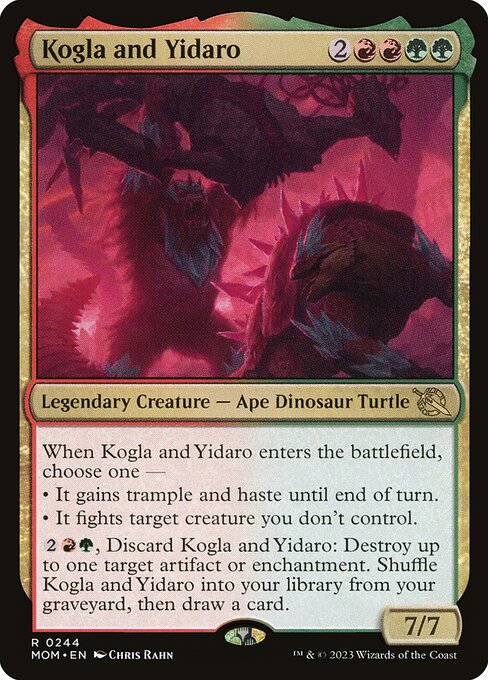
Kogla and Yidaro wants a deck that plays sturdy creatures that also deal with opponents' cards. It also suits a deck that throws away its own cards on purpose for a reward.
Mana cost
Red, Green ()
Power / toughness7 / 7
RarityRare
When Kogla and Yidaro enters, choose one —
• It gains trample and haste until end of turn.
• It fights target creature you don't control.
, Discard this card: Destroy up to one target artifact or enchantment. Shuffle this card into your library from your graveyard, then draw a card.
Picked for what they do in Kogla and Yidaro's deck. When two cards do the same job, the one with the lower comes first. All of them fit Kogla and Yidaro's color identity.Mana ValueThe total amount of mana a card costs, all added up. A card costing two generic and one green has a mana value of three. Wizards renamed this from "converted mana cost" in 2021, so older cards and articles may still use the old name.Open the full glossary
explain how Kogla and Yidaro works in tricky situations. They come from Wizards of the Coast, the company that makes Magic.RulingThe official answer to how a card works in a tricky situation. Most rulings are written by Wizards of the Coast, the company that makes Magic, and a few are notes from Scryfall, the card database Magic players use. A ruling explains a card. It does not change what the card says.Open the full glossary
Wizards of the Coast14 Apr 2023
You don't have to choose a target artifact or enchantment for the last ability. However, if you do, and that permanent is an illegal target at the time the ability tries to resolve, the ability won't resolve and none of its effects will happen. You won't shuffle Kogla and Yidaro into your library and you won't draw a card.
Color identityEvery color of mana symbol on a card, in its cost and in its rules text. Your commander's color identity sets the limit for your whole deck: every other card has to fit inside it. A deck led by a green and white commander cannot play a card with any blue in its color identity.Open the full glossaryRGPlayers write colors as letters: R for red, G for green.MidrangeMidrange decks play solid creatures that also deal with opponents' cards, attacking when it is safe and defending when it is not. They sit in the middle: slower than an all-out attacking deck, sturdier than a deck built to answer everything.Open the Midrange pageValue CreatureA creature that does two jobs: it deals with an opponent's card when it arrives, then stays as a real attacker. Its enter the battlefield ability destroys, damages, counters or bounces something, and it has 3 or more power or an ability like flying that makes it hard to block. Answering your opponent and pressuring them with the same card is what a Midrange deck is built on. Shriekmaw, Meteor GolemOpen the Value Creature pageTarget RemovalRemoves a single chosen permanent by destroying it, exiling it or returning it to its owner's hand, however big it is. It is the precise answer to one problem, as opposed to a board wipe that hits everything. Damage and -X/-X can miss a big creature, so they are Damage Removal and -X/-X Removal instead. Swords to Plowshares, Beast WithinOpen the Target Removal pageDamage RemovalRemoves creatures by dealing damage to them rather than by destroying them outright. This includes fight cards, where your creature deals the damage. Damage only kills a creature if it at least equals its toughness, so it can miss the biggest ones, and it does not kill a creature that cannot be destroyed. Lightning Bolt, Rabid Bite, PyroclasmOpen the Damage Removal pageMadness/DiscardDiscard decks throw away their own cards on purpose and play cards that reward each discard. Cards with madness can even be cast for a different, usually cheaper, cost at the moment you discard them.Open the Madness/Discard pageLootingDraws and discards in the same breath. Faithless Looting, Frantic Search. It does not gain you cards. It improves the ones you have, and fills your graveyard on purpose, which is exactly what a reanimator card like Animate Dead wants.Open the Looting pageSelf-DiscardDiscards your own cards as a cost or an effect. Filling your own graveyard on purpose is the point: it feeds cards that bring things back, madness and channel abilities, and some cards are worth more there than in hand. Faithless Looting, Boseiju, Who EnduresOpen the Self-Discard page
Send Us Feedback
What works, what's confusing, what you wish the site did. We read every one.
Not signed in? That is fine. We only keep what you write.
Optional. We only use it to reply to you.
Can we use Google Analytics cookies?
They show us which pages help people. No ads.
Privacy Policy


 Open the full glossary