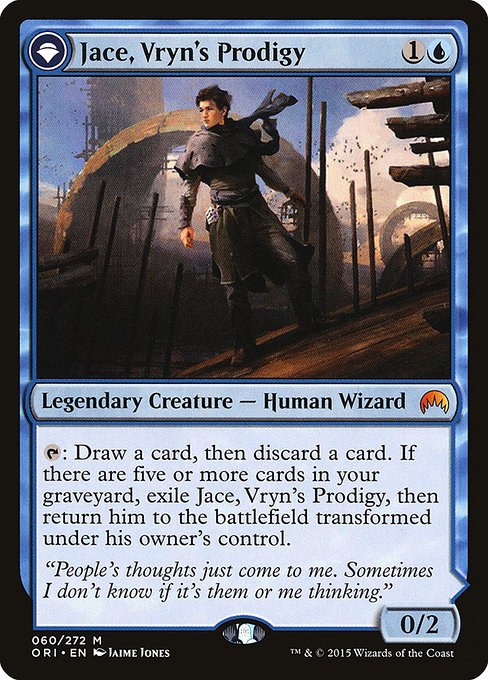
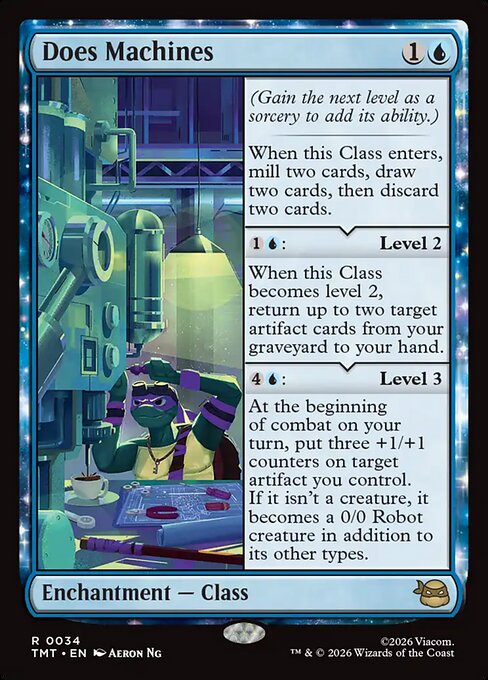
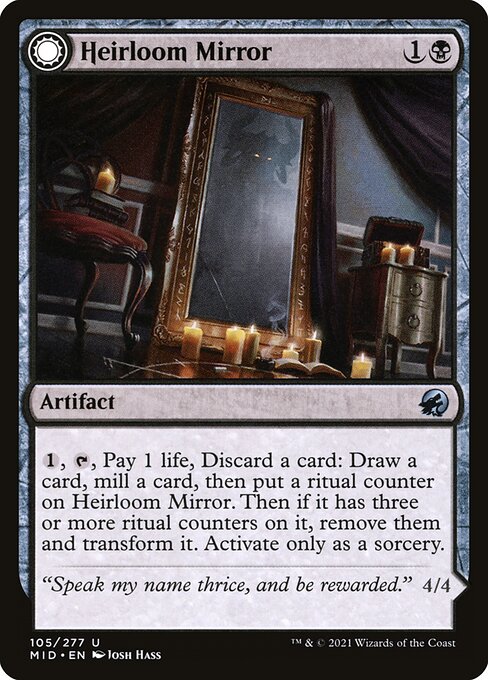
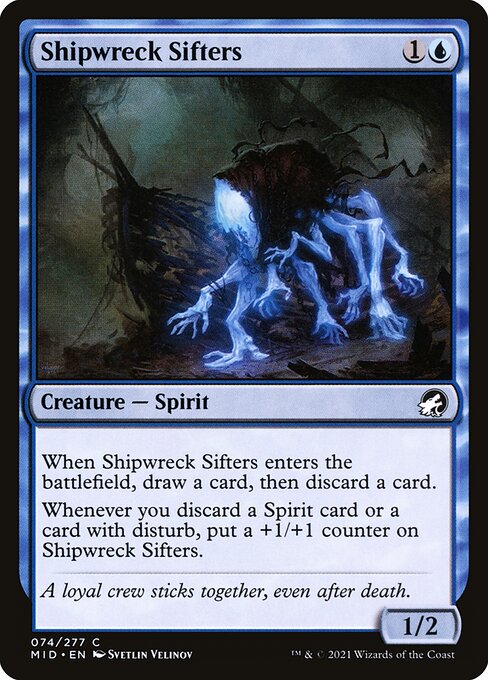
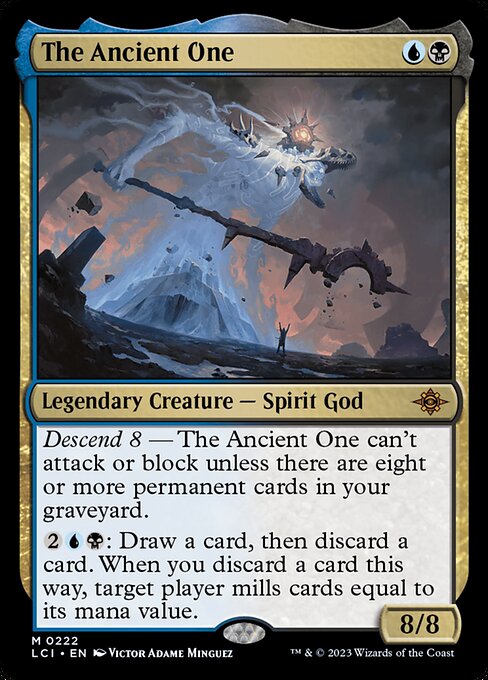
The Ancient One wants a deck that fills its discard pile and plays cards back out of it. It also suits a deck that throws away its own cards on purpose for a reward.
Mana cost
Blue, Black ()
Power / toughness8 / 8
RarityMythic
Descend 8 — The Ancient One can't attack or block unless there are eight or more permanent cards in your graveyard.
: Draw a card, then discard a card. When you discard a card this way, target player mills cards equal to its mana value.
Picked for what they do in The Ancient One's deck. When two cards do the same job, the one with the lower comes first. All of them fit The Ancient One's color identity.Mana ValueThe total amount of mana a card costs, all added up. A card costing two generic and one green has a mana value of three. Wizards renamed this from "converted mana cost" in 2021, so older cards and articles may still use the old name.Open the full glossary
explain how The Ancient One works in tricky situations. They come from Wizards of the Coast, the company that makes Magic.RulingThe official answer to how a card works in a tricky situation. Most rulings are written by Wizards of the Coast, the company that makes Magic, and a few are notes from Scryfall, the card database Magic players use. A ruling explains a card. It does not change what the card says.Open the full glossary
Wizards of the Coast10 Nov 2023
Cards with the ability word "descend N" have abilities that care if you have at least N permanent cards in your graveyard.
Wizards of the Coast10 Nov 2023
Once The Ancient One has legally attacked or blocked, removing permanent cards from your graveyard so the descend 8 ability no longer applies won't remove The Ancient One from combat.
Wizards of the Coast10 Nov 2023
Some descend triggered abilities include intervening "if" clauses (i.e. "if you have [four or eight] permanent cards in your graveyard" in the middle of the ability). Each of these abilities checks your graveyard at the moment it would trigger to see if it does. If you don't have the required number of permanent cards in your graveyard at that time, the ability doesn't trigger at all. If it does trigger, it will check again as it tries to resolve. If you don't have the required number of permanent cards in your graveyard at that time, the ability won't resolve and none of its effects will happen.
Wizards of the Coast10 Nov 2023
You don't choose a target for The Ancient One's activated ability at the time you activate it. Rather, a second "reflexive" ability triggers when you discard a card this way. You choose a target for that ability as it goes on the stack. Each player may respond to this triggered ability as normal.
Color identityEvery color of mana symbol on a card, in its cost and in its rules text. Your commander's color identity sets the limit for your whole deck: every other card has to fit inside it. A deck led by a green and white commander cannot play a card with any blue in its color identity.Open the full glossaryUBPlayers write colors as letters: U for blue, B for black. Blue is U because B was already taken by black.Graveyard/Self-MillGraveyard decks fill their own graveyard on purpose, then play cards from it as if it were a second hand. Moving cards from the top of your own deck straight into the graveyard is called self-mill.Open the Graveyard/Self-Mill pageMillPuts cards from the top of a player's library, the deck they draw from, straight into their graveyard. Aimed at opponents it can win the game, because a player who has to draw from an empty library loses.Open the Mill pageLootingDraws and discards in the same breath. Faithless Looting, Frantic Search. It does not gain you cards. It improves the ones you have, and fills your graveyard on purpose, which is exactly what a reanimator card like Animate Dead wants.Open the Looting pageGraveyard PayoffRewards you for having cards in your graveyard, or uses them straight from there. Your graveyard is normally where cards go once they are finished with; these turn it into a second hand, and the fuller it is the better they get. Golgari Grave-Troll, SplinterfrightOpen the Graveyard Payoff pageSelf-DiscardDiscards your own cards as a cost or an effect. Filling your own graveyard on purpose is the point: it feeds cards that bring things back, madness and channel abilities, and some cards are worth more there than in hand. Faithless Looting, Boseiju, Who EnduresOpen the Self-Discard pageMadness/DiscardDiscard decks throw away their own cards on purpose and play cards that reward each discard. Cards with madness can even be cast for a different, usually cheaper, cost at the moment you discard them.Open the Madness/Discard pageMillMill decks win by emptying opponents' libraries, the decks they draw from: a player who has to draw from an empty library loses the game. Milling means putting cards from the top of a library straight into the graveyard.Open the Mill pageMana SinkGives you somewhere useful to spend spare mana, usually through an ability you can activate again and again. Rogue's Passage, Mind StoneOpen the Mana Sink pageDrawDraws you extra cards. More cards means more choices every turn, and in a 100-card deck it is the main way to find the pieces you need. Rhystic Study, SkullclampOpen the Draw pageGods / DevotionGods, and cards that count your devotion: the number of mana symbols of one color among the costs of your permanents. The Theros Gods cannot be destroyed, and only become creatures when your devotion to their color is high enough.Open the Gods / Devotion pageGame ChangerCards that warp the game disproportionately around themselves, requiring immediate answers.What the brackets mean
Send Us Feedback
What works, what's confusing, what you wish the site did. We read every one.
Not signed in? That is fine. We only keep what you write.
Optional. We only use it to reply to you.
Can we use Google Analytics cookies?
They show us which pages help people. No ads.
Privacy Policy


 Open the full glossary