

Star Trek
Star Trek is a : 5 drops and 25 cards. A theme groups drops that share a franchise or an idea.Secret LairSpecial Magic cards sold by Wizards of the Coast on their own online store for a short time. Most are cards that already exist, given new art by a well-known artist or another franchise. A Secret Lair copy of a card plays exactly like any other copy of it.Open the full glossaryThemeOur way of grouping Secret Lair drops that share a subject, like Marvel or Fallout, so every version is on one page.Open the full glossary
Released 5 drops 25 cards
Sign in to see which of these cards you already own. Sign in We could not check your collection just now. Try again in a minute.
We do not sell anything and we are not paid for this. Secret Lair is sold by Wizards of the Coast.
Every drop
Click a card for the card itself, the decks that play it and, once you are signed in, whether you already own a copy. To mark every card here at once, press Show what I own. A foil is the shiny version of a card. Secret Lair sells it as a separate Foil Edition of the same drop.
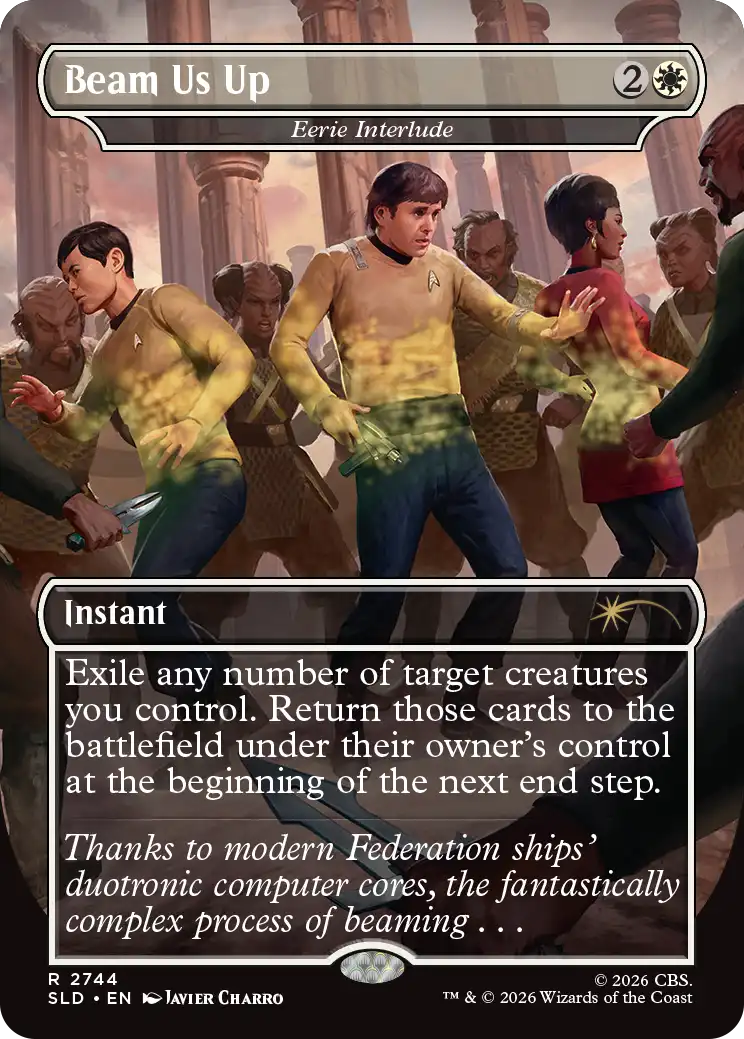
Secret Lair x Star Trek: Beam Me Up Not yet released 4 cards
Four reversible cards, each with different art on its back: Eerie Interlude as "Beam Us Up", Momentary Blink, Essence Flux as "Materialize" and Conjurer's Closet as "The Transporter". Part of the Set Phasers to Superdrop, on sale November 9, 2026. Card pictures will appear once they are listed on Scryfall.
Secret Lair x Star Trek: KHAAAAAAAAN Not yet released 6 cards
Six cards: Wrath of the Skies as "Best Served Cold", Commandeer, Illusionist's Gambit as "Reliant's Betrayal", Buried Alive, Genesis Wave and Fracture. Part of the Set Phasers to Superdrop, on sale November 9, 2026.


Secret Lair x Star Trek: Lower Decks Not yet released 5 cards
Five Lower Decks crew cards: Inti as "Mariner, Breaching Protocol", Kambal as "Boimler, Citing Protocol", Silas Renn as "Rutherford, Rebuilding the Past", Thrasios as "Tendi, Exploring the Future" and Weatherlight as "U.S.S. Cerritos, California-Class". Part of the Set Phasers to Superdrop, on sale November 9, 2026.


Secret Lair x Star Trek: New Worlds Not yet released 5 cards


Secret Lair x Star Trek: tlhIngan maH Not yet released 5 cards
Five reversible cards, each with different art on its back: Demand Answers, Relentless Assault, Seething Song, War's Toll and Warstorm Surge. Part of the Set Phasers to Superdrop, on sale November 9, 2026. Card pictures will appear once they are listed on Scryfall.
Rulings for the Cards on This Page
explain how a card works in tricky situations. They come from Wizards of the Coast, the company that makes Magic.RulingThe official answer to how a card works in a tricky situation. Most rulings are written by Wizards of the Coast, the company that makes Magic, and a few are notes from Scryfall, the card database Magic players use. A ruling explains a card. It does not change what the card says.Open the full glossary
58 rulings for 10 cards
Buried Alive
You can look in your library and then choose to find any number from zero to three creatures after you look at it.
Commandeer
If you Commandeer a spell for which buyback has been paid, the card returns to its owner's hand.
You may change any of the targeted spell's targets. If you change a target, you must choose a legal target for the spell. If you can't, you must leave the target the same (even if that target is now illegal).
You may pay the alternative cost rather than the card's mana cost. Any additional costs are paid as normal.
If the targeted spell has a triggered ability that copies it (for example, replicate or storm), the copies will be controlled by the player who cast that spell.
After Commandeer resolves, you control the targeted spell. Any instance of "you" in that spell's text now refers to you, "an opponent" refers to one of your opponents, and so on. The change of control happens before new targets are chosen, so any targeting restrictions such as "target opponent" or "target creature you control" are now made in reference to you, not the spell's original controller. You may either change those targets to be legal in reference to you, or, if those are the spell's only targets, the spell doesn't resolve for having illegal targets. When the spell resolves, any illegal targets are unaffected by it and you make all decisions the spell's effect calls for.
If you don't have two cards of the right color in your hand, you can't choose to cast the spell using the alternative cost.
You can't exile a card from your hand to pay for itself. At the time you would pay costs, that card is on the stack, not in your hand.
If you gain control of an instant or sorcery spell with Commandeer, it will still be put into its owner's graveyard when it resolves.
Genesis Wave
If a card in a player's library has {X} in its mana cost, X is considered to be 0.
If a permanent card in your library has no mana symbols in its upper right corner (because it's a land card, for example), its mana value is 0. Such cards can always be put onto the battlefield with Genesis Wave.
You don't have to put permanent cards revealed this way onto the battlefield if you choose not to, regardless of their mana values.
A permanent card is an artifact, battle, creature, enchantment, land, or planeswalker card.
All of the permanents put onto the battlefield this way enter at the same time. If any have triggered abilities that trigger on something else entering, they'll see each other.
If you have fewer than X cards in your library, you reveal all of them.
Illusionist's Gambit
Creatures that didn't attack during the combat phase when Illusionist's Gambit resolved aren't required to attack in the additional combat phase, although they may. Those creatures can attack you or a planeswalker you control.
If, during a player's declare attackers step, a creature is tapped, is affected by a spell or ability that says it can't attack, or hasn't been under that player's control continuously since the turn began (and doesn't have haste), then it doesn't attack.
If there's a cost associated with having a creature attack, the player isn't forced to pay that cost, so it doesn't have to attack.
Inti, Seneschal of the Sun
You don't choose a target for Inti, Seneschal of the Sun's first ability at the time it triggers. Rather, a second "reflexive" ability triggers when you discard a card this way. You choose targets for that ability as it goes on the stack. Each player may respond to this triggered ability as normal.
You pay all costs and follow all normal timing rules for cards played due to the last ability. For example, if the exiled card is a land card, you may play it only during your main phase while the stack is empty.
Kambal, Profiteering Mayor
Each of the new tokens copies the original characteristics of the appropriate token as stated by the effect that created that token and nothing else (unless that creature is copying something else; see below). It doesn’t copy whether the opponent’s token is tapped or untapped, whether it has any counters on it or Auras and Equipment attached to it, or any non-copy effects that have changed its power, toughness, types, color, and so on.
If the copied token is copying something else, then the new token enters the battlefield as whatever that token copied.
If the copied token has {X} in its mana cost, X is 0. (Most tokens don’t have a mana cost unless they’re copying something else.)
Any enters-the-battlefield abilities of the copied token will trigger when the token enters the battlefield. Any “as [this permanent] enters the battlefield” or “[this permanent] enters the battlefield with” abilities of the copied token will also work.
Silas Renn, Seeker Adept
You pay the costs for the target artifact card if you cast it. You may pay alternative costs rather than the card's mana cost.
You may cast that card this turn even if Silas Renn leaves the battlefield.
Silas Renn doesn't change when you can cast the target artifact card. For example, if you target an artifact card without flash, you can cast it only during your main phase when the stack is empty.
Once the game begins, your two commanders are tracked separately. If you cast one, you won't have to pay an additional {2} the first time you cast the other. A player loses the game after having been dealt 21 damage from any one of them, not from both of them combined.
Casting the card causes it to leave your graveyard and become a new object. You can't cast it multiple times.
Both commanders start in the command zone, and the remaining 98 cards (or 58 cards in a Commander Draft game) of your deck are shuffled to become your library.
An effect that checks whether you control your commander is satisfied if you control one or both of your two commanders.
If you don't cast the card, it remains in your graveyard.
An effect that instructs you to "cast" a card doesn't allow you to play lands.
If your Commander deck has two commanders, you can only include cards whose own color identities are also found in your commanders' combined color identities. If Falthis and Kediss are your commanders, your deck may contain cards with black and/or red in their color identity, but not cards with green, white, or blue.
If something refers to your commander while you have two commanders, it refers to one of them of your choice. If you are instructed to perform an action on your commander (e.g. put it from the command zone into your hand due to Command Beacon), you choose one of your commanders at the time the effect happens.
To have two commanders, both must have the partner ability as the game begins. Losing the ability during the game doesn't cause either to cease to be your commander.
You can choose two commanders with partner that are the same color or colors. In Commander Draft, you can even choose two of the same commander with partner if you drafted them. If you do this, make sure you keep the number of times you've cast each from the command zone clear for "commander tax" purposes.
Thrasios, Triton Hero
Once the game begins, your two commanders are tracked separately. If you cast one, you won't have to pay an additional {2} the first time you cast the other. A player loses the game after having been dealt 21 damage from any one of them, not from both of them combined.
The nonland card you reveal will be the card you draw.
Both commanders start in the command zone, and the remaining 98 cards (or 58 cards in a Commander Draft game) of your deck are shuffled to become your library.
An effect that checks whether you control your commander is satisfied if you control one or both of your two commanders.
If your Commander deck has two commanders, you can only include cards whose own color identities are also found in your commanders' combined color identities. If Falthis and Kediss are your commanders, your deck may contain cards with black and/or red in their color identity, but not cards with green, white, or blue.
If something refers to your commander while you have two commanders, it refers to one of them of your choice. If you are instructed to perform an action on your commander (e.g. put it from the command zone into your hand due to Command Beacon), you choose one of your commanders at the time the effect happens.
To have two commanders, both must have the partner ability as the game begins. Losing the ability during the game doesn't cause either to cease to be your commander.
You can choose two commanders with partner that are the same color or colors. In Commander Draft, you can even choose two of the same commander with partner if you drafted them. If you do this, make sure you keep the number of times you've cast each from the command zone clear for "commander tax" purposes.
No player may take another action while you're resolving the activated ability.
Weatherlight
A card, spell, or permanent is historic if it has the legendary supertype, the artifact card type, or the Saga subtype. Having two of those qualities doesn't make an object more historic than another or provide an additional bonus—an object either is historic or it isn't.
Wrath of the Skies
Some triggered abilities state that you "may pay" a certain amount of {E}. You can't pay that amount multiple times to multiply the effect. You simply choose whether or not to pay that amount of {E} as the ability resolves.
Choosing not to pay any {E} will have the same result as choosing to pay zero {E}. In either of these cases, each artifact, creature, and enchantment with a mana value of 0 will be destroyed.
{E} is the energy symbol. It represents one energy counter.
If a permanent on the battlefield has {X} in its mana cost, X is 0 when determining its mana value.
If a spell or ability with one or more targets states that you "may pay" some amount of {E}, and each permanent that it targets has become an illegal target, the spell or ability won't resolve. You can't pay any {E} even if you want to.
Energy counters are a kind of counter that a player may have. They're not associated with any specific permanents.
If an effect says you get one or more {E}, you get that many energy counters. To pay one or more {E}, you lose that many energy counters. You can't pay more energy counters than you have. Any effects that interact with counters a player gets, has, or loses can interact with energy counters.
Energy counters aren't mana. They don't go away as steps, phases, and turns end, and effects that add mana "of any type" can't give you energy counters.
Some triggered abilities that state that you "may pay" a certain amount of {E} describe an effect that happens "If you do." In that case, no player may take actions to try to stop the ability's effect after you make your choice. If the payment is followed by the phrase "When you do," then you'll choose any targets for that reflexive triggered ability and put it on the stack before players can take actions.
Some spells and abilities that give you {E} may require targets. If each target chosen is an illegal target as that spell or ability tries to resolve, it won't resolve. You won't get any {E}.
Keep track of how many energy counters each player has. Potential ways to track this include writing theme down on paper or using dice, but any method that is clear and mutually agreeable is fine. (At higher levels of tournament play, dice may not be allowed for tracking counters that players have.)
Also Printed in Other Drops
Some of these cards came in other Secret Lair drops too, each with its own art.
- Buried AliveMonty Python and the Holy Grail: Vol. 1
- Eerie InterludeThe Zeta Set
- ForestThe Oddlands: Forests, The Oddlands: Islands, The Oddlands: Mountains, The Oddlands: Plains, The Oddlands: Swamps
- IslandSecret Lair Commander Deck: Odds and Ends, The Oddlands: Forests, The Oddlands: Islands, The Oddlands: Mountains, The Oddlands: Plains
- MountainThe Oddlands: Forests, The Oddlands: Islands, The Oddlands: Mountains, The Oddlands: Plains, The Oddlands: Swamps
- PlainsSecret Lair Commander Deck: Odds and Ends, The Oddlands: Forests, The Oddlands: Islands, The Oddlands: Mountains, The Oddlands: Plains
- Seething SongGoblin Storm
- SwampSecret Lair Commander Deck: Odds and Ends, The Oddlands: Forests, The Oddlands: Islands, The Oddlands: Mountains, The Oddlands: Plains
- WeatherlightSonic: Turbo Gear
Portions of Commander Nexus are unofficial Fan Content permitted under the Fan Content Policy. Not approved or endorsed by Wizards. Literal and graphical information about Magic: The Gathering, including card images and mana symbols, is copyright Wizards of the Coast, LLC.