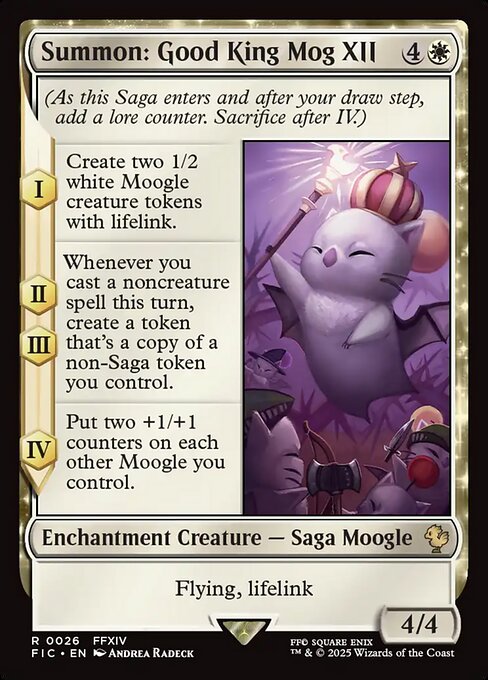
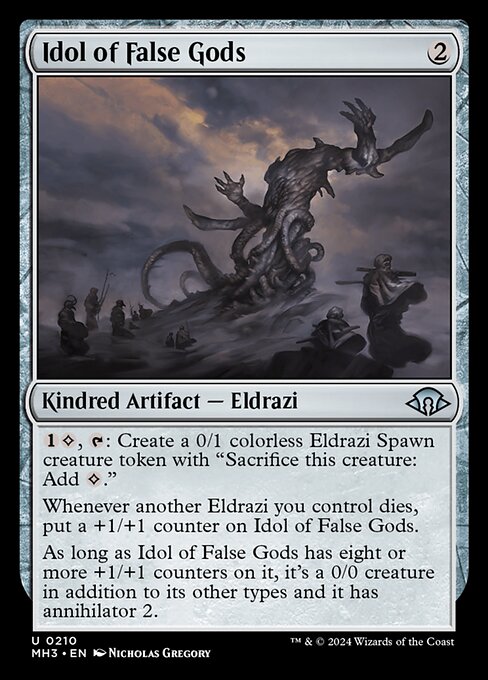
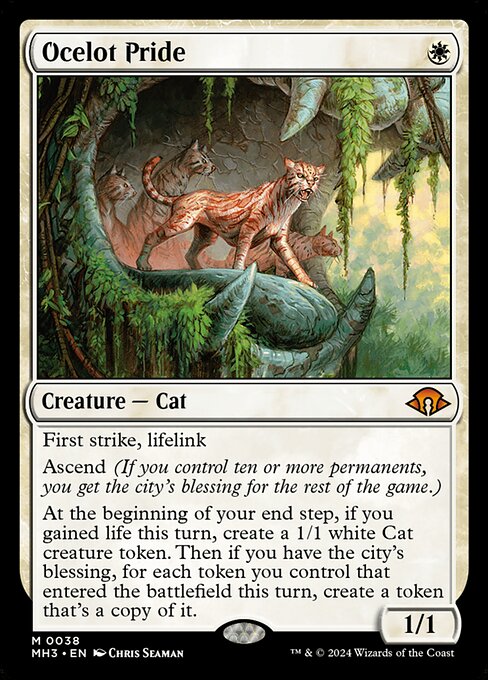
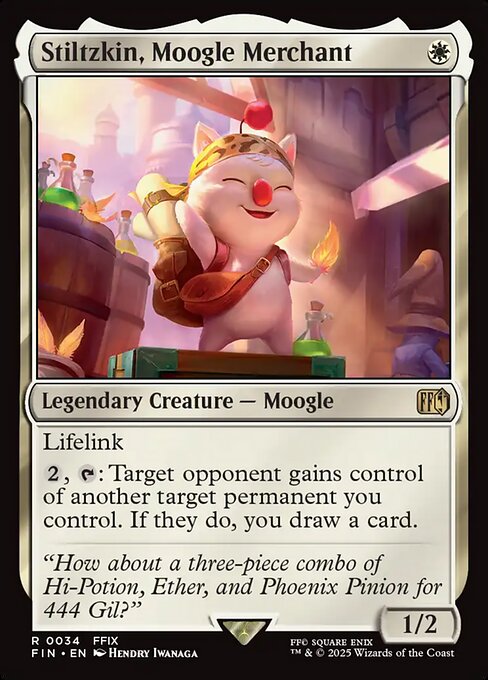
Mog wants a deck that throws away its own cards on purpose for a reward. It also suits a deck that is built around one creature type, like Elves or Dragons.
Mana cost
White, Red ()
Power / toughness1 / 2
RarityRare
Lifelink
Dance — At the beginning of your end step, each player may discard a card. Each player who discarded a card this way draws a card. If a creature card was discarded this way, you create a 1/2 white Moogle creature token with lifelink. Then if a noncreature card was discarded this way, put a +1/+1 counter on each Moogle you control.
Picked for what they do in Mog's deck. When two cards do the same job, the one with the lower comes first. All of them fit Mog's color identity.Mana ValueThe total amount of mana a card costs, all added up. A card costing two generic and one green has a mana value of three. Wizards renamed this from "converted mana cost" in 2021, so older cards and articles may still use the old name.Open the full glossary
explain how Mog works in tricky situations. They come from Wizards of the Coast, the company that makes Magic.RulingThe official answer to how a card works in a tricky situation. Most rulings are written by Wizards of the Coast, the company that makes Magic, and a few are notes from Scryfall, the card database Magic players use. A ruling explains a card. It does not change what the card says.Open the full glossary
Wizards of the Coast6 Jun 2025
As long as at least one creature card was discarded this way, you'll create a Moogle token, and as long as at least one noncreature card was discarded this way, you'll put a +1/+1 counter on each Moogle you control. Additional creature cards discarded beyond the first won't result in additional Moogle tokens, and additional noncreature cards discarded beyond the first won't result in additional counters.
Color identityEvery color of mana symbol on a card, in its cost and in its rules text. Your commander's color identity sets the limit for your whole deck: every other card has to fit inside it. A deck led by a green and white commander cannot play a card with any blue in its color identity.Open the full glossaryWRPlayers write colors as letters: W for white, R for red.Madness/DiscardDiscard decks throw away their own cards on purpose and play cards that reward each discard. Cards with madness can even be cast for a different, usually cheaper, cost at the moment you discard them.Open the Madness/Discard pageSelf-DiscardDiscards your own cards as a cost or an effect. Filling your own graveyard on purpose is the point: it feeds cards that bring things back, madness and channel abilities, and some cards are worth more there than in hand. Faithless Looting, Boseiju, Who EnduresOpen the Self-Discard pageToken MakerCreates one or more tokens. Different cards make very different ones: creatures Grave Titan, Treasures Smothering Tithe, Clues Tireless Tracker or Food Gilded Goose. This is one of our largest tags, so pair it with an archetype or theme when you are hunting a specific kind.Open the Token Maker pageOpponent DiscardMakes opponents discard cards from their hands. In a format where everyone starts with seven and refills slowly, stripping a hand can be harder to recover from than losing a creature. Windfall, Sword of Feast and FamineOpen the Opponent Discard pageDrawDraws you extra cards. More cards means more choices every turn, and in a 100-card deck it is the main way to find the pieces you need. Rhystic Study, SkullclampOpen the Draw pageTypal/KindredTypal decks are built around one creature type, like Elves, Dragons or Zombies, with cards that make that type stronger. The type is printed after the dash on the card's type line, and the strategy is also called kindred or tribal.Open the Typal/Kindred pageTypal PayoffRewards you for playing lots of one kind of creature. That includes "lords" that make every other Goblin or Merfolk you control bigger, and cards that ask you to choose a creature type and then pay you off for it. A creature type is the word on the middle line of the card, like Goblin, Elf or Zombie.Open the Typal Payoff pageToken EngineMakes tokens again and again rather than once. A token is a creature or other permanent created by a card, with no card of its own. Something that makes one token gives you a body; something that makes them every turn gives you a board you can keep rebuilding after it is cleared. Grave Titan, Bitterblossom, OphiomancerOpen the Token Engine pageLife GainGains you life, once or over and over. Soul Warden, The Great Henge. In Commander life is something to spend, not just a cushion, and many of these cards also set off others that reward gaining life.Open the Life Gain pageTokensToken decks fill the battlefield with small creatures made by their cards, then attack with all of them or make them all bigger at once. A token is a creature (or other object) that a card creates, not a card from your deck.Open the Tokens page+1/+1 CountersPuts +1/+1 counters on creatures, permanently raising their power and toughness. Unlike a temporary boost that wears off at end of turn, these markers stay put and stack up over a long game. Hardened Scales, The Great HengeOpen the +1/+1 Counters page
Send Us Feedback
What works, what's confusing, what you wish the site did. We read every one.
Not signed in? That is fine. We only keep what you write.
Optional. We only use it to reply to you.
Can we use Google Analytics cookies?
They show us which pages help people. No ads.
Privacy Policy


 Open the full glossary