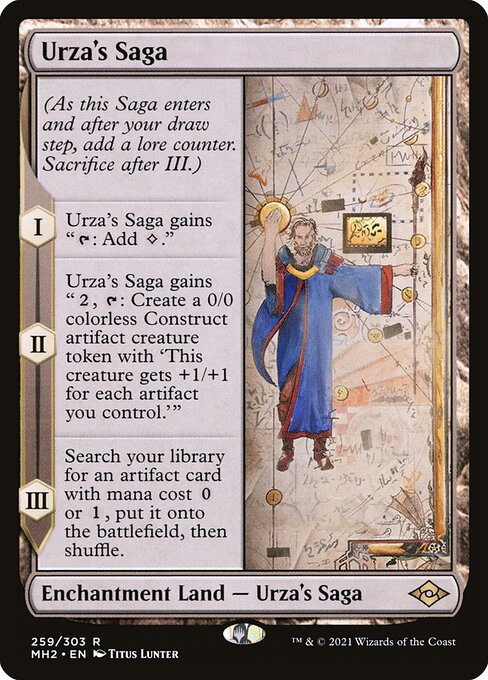
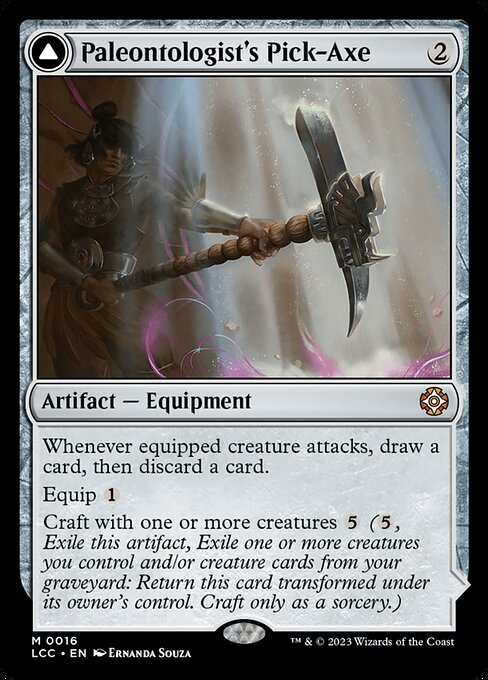
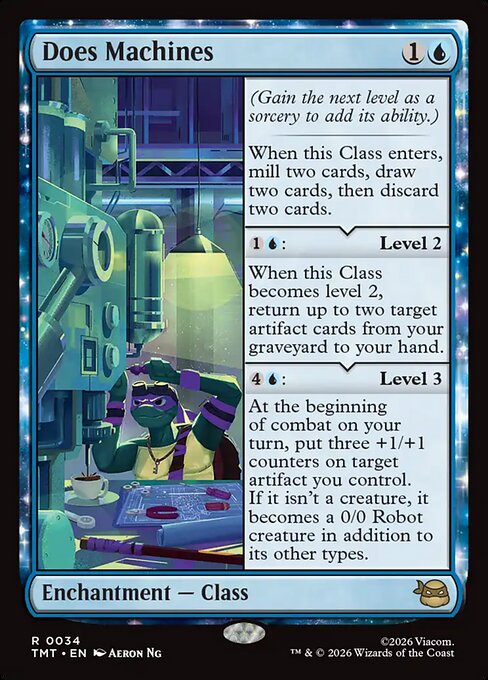
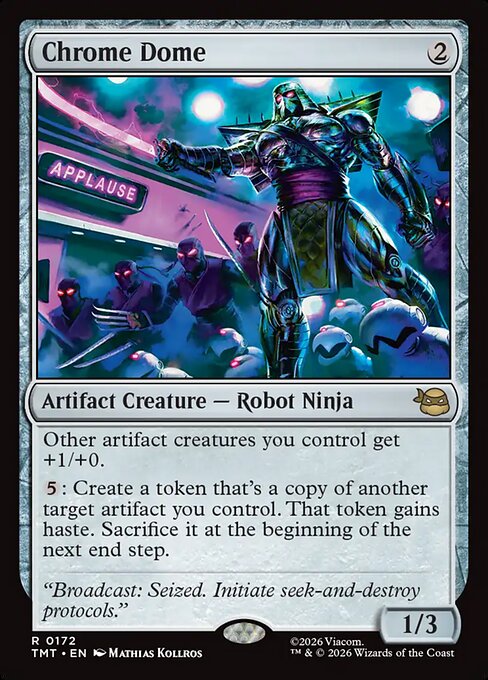
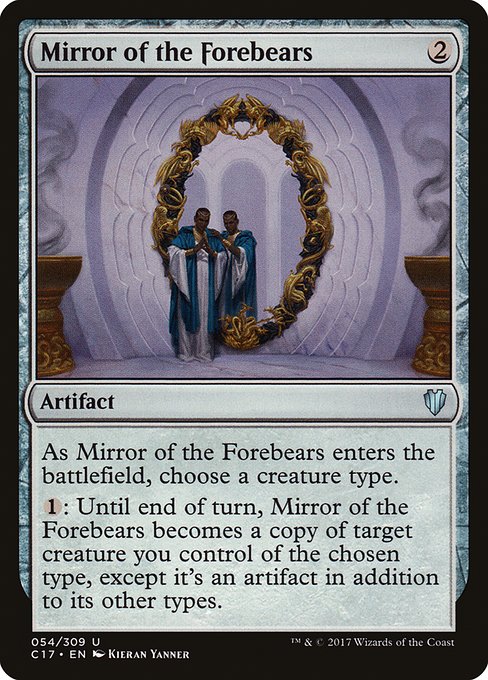
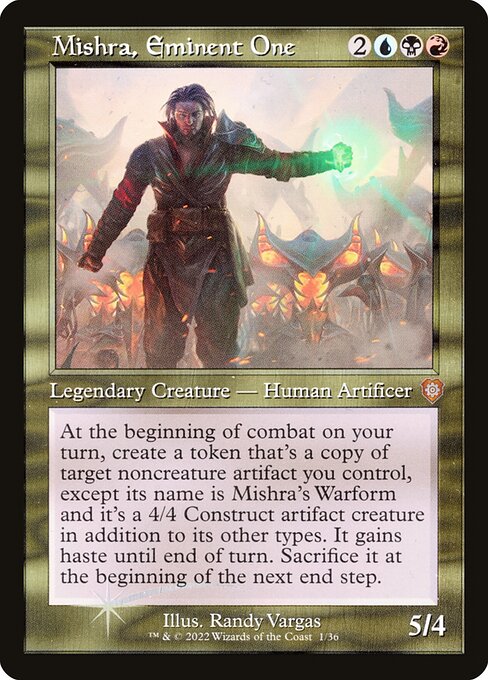
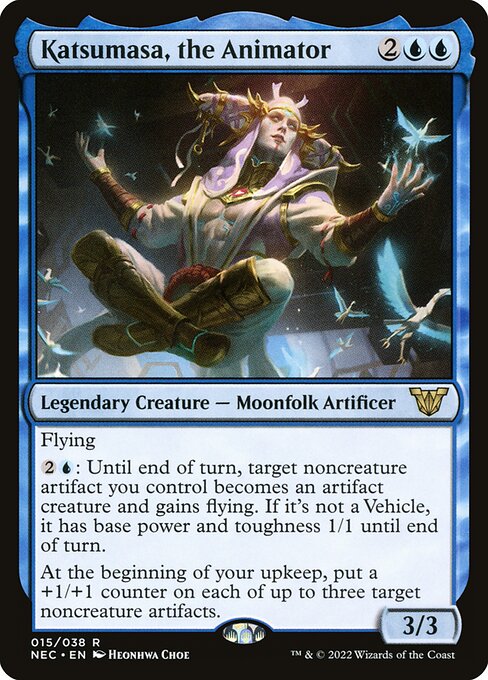
Curie wants a deck that fills the table with artifacts that make mana and draw cards. It also suits a deck that copies the best creature on the table.
Mana cost
Blue ()
Power / toughness1 / 3
RarityRare
Whenever Curie deals combat damage to a player, draw cards equal to its base power.
, Exile another nontoken artifact creature you control: Curie becomes a copy of the exiled creature, except it has "Whenever this creature deals combat damage to a player, draw cards equal to its base power."
Picked for what they do in Curie's deck. When two cards do the same job, the one with the lower comes first. All of them fit Curie's color identity.Mana ValueThe total amount of mana a card costs, all added up. A card costing two generic and one green has a mana value of three. Wizards renamed this from "converted mana cost" in 2021, so older cards and articles may still use the old name.Open the full glossary
explain how Curie works in tricky situations. They come from Wizards of the Coast, the company that makes Magic.RulingThe official answer to how a card works in a tricky situation. Most rulings are written by Wizards of the Coast, the company that makes Magic, and a few are notes from Scryfall, the card database Magic players use. A ruling explains a card. It does not change what the card says.Open the full glossary
Wizards of the Coast8 Mar 2024
Curie's last ability refers to the exiled creature, not the exiled card. In most cases, this means Curie copies exactly what was printed on the original creature and nothing else, plus the additional ability. However, if the exiled creature was copying something else when it was last on the battlefield, Curie copies whatever that creature was copying, plus the additional ability.
Wizards of the Coast8 Mar 2024
Curie's last ability won't copy whether the exiled creature was tapped or untapped, whether it had any counters on it or Auras attached to it, or any non-copy effects that changed its power, toughness, types, color, and so on.
Wizards of the Coast8 Mar 2024
If a creature has a characteristic-defining ability that sets its power, indicated with a * or similar in the power and toughness box, that ability is taken into account when determining its base power.
Wizards of the Coast8 Mar 2024
If Curie is no longer on the battlefield when its first ability resolves, use its base power as it last existed on the battlefield to determine how many cards to draw.
Wizards of the Coast8 Mar 2024
If the copied creature has {X} in its mana cost, X is 0.
Wizards of the Coast8 Mar 2024
Normally, a creature's base power is the power printed on the card, or, for a token, the power set by the effect that created it. If another effect sets a creature's power to a specific number or value, that becomes its base power. If an effect modifies a creature's power without setting it, that is not included when determining its base power.
Color identityEvery color of mana symbol on a card, in its cost and in its rules text. Your commander's color identity sets the limit for your whole deck: every other card has to fit inside it. A deck led by a green and white commander cannot play a card with any blue in its color identity.Open the full glossaryUPlayers write colors as letters: U for blue. Blue is U because B was already taken by black.ArtifactsAn artifacts deck fills the battlefield with artifacts, cards like Sol Ring that stay in play and keep working turn after turn. Played together, they give you extra mana and extra cards. A handful of keywords turn up on artifacts again and again. Equip means you pay a cost to attach an Equipment such as Swiftfoot Boots to one of your creatures. If that creature dies, the Equipment does not go to your graveyard with it. It stays on the battlefield, and you can pay the cost again to attach it to another creature. Crew means you tap your own creatures with enough total power between them to turn a Vehicle such as Smuggler's Copter into a creature until the end of the turn. A Treasure is a token you can sacrifice (put into your graveyard on purpose) for one mana of any color. A token is a game piece that a card makes, not a card from your deck, and Pitiless Plunderer is one card that makes Treasures. Affinity makes a spell like Frogmite cheaper for each artifact you control. Unearth brings a card like Combat Courier back from your graveyard for one turn, and then it is exiled. Modular creatures like Arcbound Ravager enter with +1/+1 counters and pass them to another artifact creature when they die.Open the Artifacts pageMana SinkGives you somewhere useful to spend spare mana, usually through an ability you can activate again and again. Rogue's Passage, Mind StoneOpen the Mana Sink pageAnimate ArtifactTurns artifacts into creatures so they can attack and block. It is a trade: they gain a body, and they become vulnerable to anything that destroys creatures. Mirage Mirror, Inkmoth NexusOpen the Animate Artifact pageDrawDraws you extra cards. More cards means more choices every turn, and in a 100-card deck it is the main way to find the pieces you need. Rhystic Study, SkullclampOpen the Draw pageClonesClone decks copy the best creature on the battlefield, whoever owns it, so they always have one of the strongest things on the table. A copy also gets the original's 'when this enters' ability, so each clone can bring a fresh effect too.Open the Clones pageCloneCopies a creature or another permanent already on the battlefield. Copying the best thing on the table is often cheaper than casting something equally strong. Phyrexian Metamorph, Helm of the HostOpen the Clone pageSaboteurTriggers when a creature deals combat damage to a player, so the reward comes from connecting rather than from the damage itself. Evasion makes these far more reliable. Ragavan, Nimble PilfererOpen the Saboteur page
Send Us Feedback
What works, what's confusing, what you wish the site did. We read every one.
Not signed in? That is fine. We only keep what you write.
Optional. We only use it to reply to you.
Can we use Google Analytics cookies?
They show us which pages help people. No ads.
Privacy Policy


 Open the full glossary