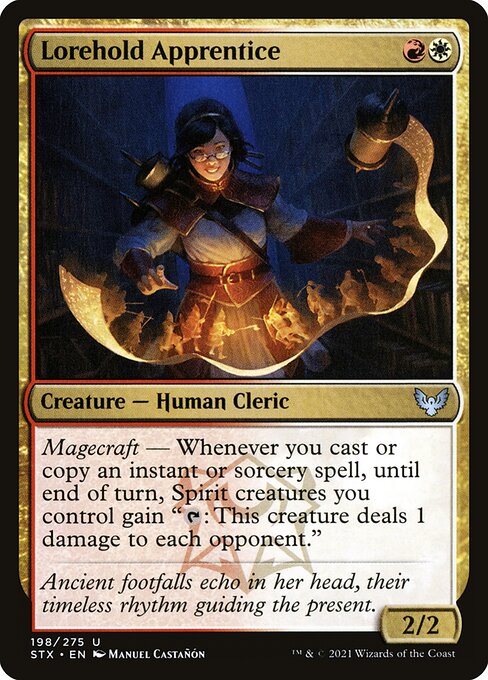
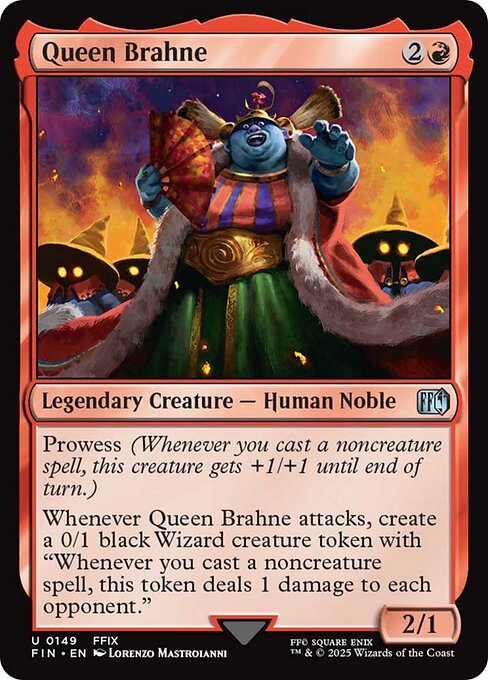
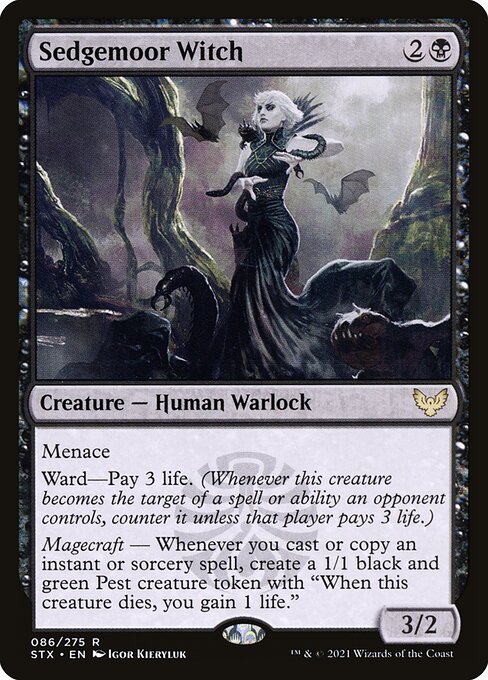
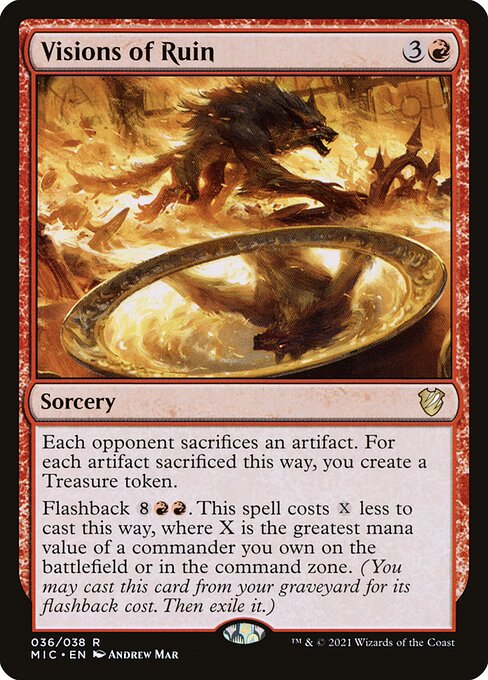
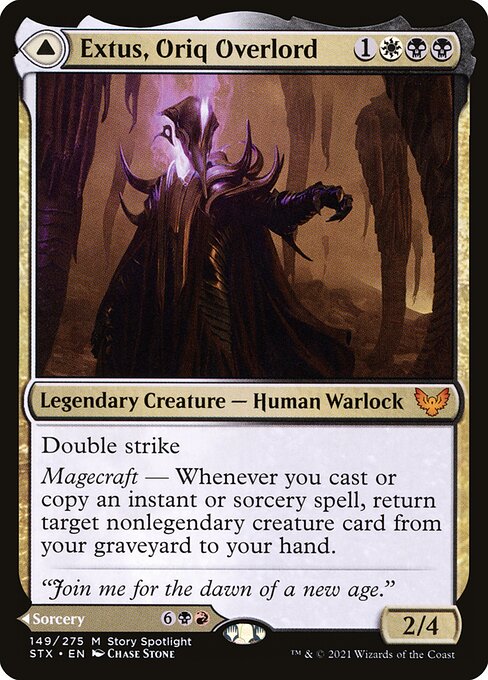
Extus wants a deck that casts lots of instant and sorcery spells. It also suits a deck that gives up its own cards on purpose to get something back.
Mana cost
White, Black, Red ()
Power / toughness2 / 4
RarityMythic
Double strike
Magecraft — Whenever you cast or copy an instant or sorcery spell, return target nonlegendary creature card from your graveyard to your hand.
//
As an additional cost to cast this spell, you may sacrifice any number of creatures. This spell costs less to cast for each creature sacrificed this way.
Each opponent sacrifices a creature of their choice. Create a 3/6 black and red Avatar creature token with haste and "Whenever this token attacks, it deals 3 damage to each opponent."
Picked for what they do in Extus's deck. When two cards do the same job, the one with the lower comes first. All of them fit Extus's color identity.Mana ValueThe total amount of mana a card costs, all added up. A card costing two generic and one green has a mana value of three. Wizards renamed this from "converted mana cost" in 2021, so older cards and articles may still use the old name.Open the full glossary
explain how Extus works in tricky situations. They come from Wizards of the Coast, the company that makes Magic.RulingThe official answer to how a card works in a tricky situation. Most rulings are written by Wizards of the Coast, the company that makes Magic, and a few are notes from Scryfall, the card database Magic players use. A ruling explains a card. It does not change what the card says.Open the full glossary
Wizards of the Coast16 Apr 2021
As Awaken the Blood Avatar resolves, first the next opponent in turn order (or, if it’s an opponent’s turn, the opponent whose turn it is) chooses a creature they control, then each other opponent in turn order does the same knowing the choices made before them. Then all the chosen creatures are sacrificed at the same time.
Wizards of the Coast16 Apr 2021
Awaken the Blood Avatar’s first ability can’t reduce its cost below {B}{R}. However, you can sacrifice any number of creatures, even if they won’t reduce its cost any further.
Wizards of the Coast16 Apr 2021
Each magecraft ability has a different effect, although they all have the same trigger condition, whenever you cast or copy an instant or sorcery spell.
Wizards of the Coast16 Apr 2021
For example, if you control Archmage Emeritus and cast an instant or sorcery spell, Archmage Emeritus’s magecraft ability will trigger and you will draw a card.
Wizards of the Coast16 Apr 2021
If an effect creates a copy of an instant or sorcery spell, this will also cause the magecraft ability to trigger.
Wizards of the Coast16 Apr 2021
If an effect creates multiple copies of an instant or sorcery spell, magecraft abilities trigger once for each copy created by the effect.
Wizards of the Coast16 Apr 2021
Include any additional costs to cast Awaken the Blood Avatar before applying its own cost reduction. For example, if Extus is your commander, and an additional cost of {6} applies from the “commander tax,” you may cast Awaken the Blood Avatar by sacrificing four creatures and paying {4}{B}{R}.
Wizards of the Coast16 Apr 2021
Returning a nonlegendary creature card is not optional. If there is at least one in your graveyard, you must target it with the magecraft ability.
Wizards of the Coast16 Apr 2021
Some effects instruct you to copy an instant or sorcery card in a zone other than the stack. These copies do not cause magecraft abilities to trigger. However, most effects that do this also allow you to cast the copy, and casting the copy will cause magecraft abilities to trigger.
Wizards of the Coast16 Apr 2021
The Blood Avatar will be awakened even if no player has creatures to sacrifice when it resolves.
Color identityEvery color of mana symbol on a card, in its cost and in its rules text. Your commander's color identity sets the limit for your whole deck: every other card has to fit inside it. A deck led by a green and white commander cannot play a card with any blue in its color identity.Open the full glossaryWBRPlayers write colors as letters: W for white, B for black, R for red.SpellslingerSpellslinger decks cast lots of instants and sorceries, one-time spells, and play creatures that reward every spell you cast. Instants and sorceries take effect once and then go to your graveyard, and an instant can even be cast during another player's turn.Open the Spellslinger pageSpellslinger PayoffRewards you specifically for casting or copying instants and sorceries, usually with a trigger each time. Narrower than Spellslinger, which covers the whole instant-and-sorcery family. Archmage Emeritus, Storm-Kiln ArtistOpen the Spellslinger Payoff pageMass BurnDeals damage to everything, or to every opponent at once, rather than to a single target. In a four player game the same card hits three people, so small repeated amounts add up quickly. Blasphemous Act, Impact TremorsOpen the Mass Burn pageSpellslingerRewards you for casting instants and sorceries, usually triggering each time you cast one. Storm-Kiln Artist, GuttersnipeOpen the Spellslinger pageSacrificeSacrifice decks give up their own creatures, Treasures and other cards on purpose and get something back each time. A sacrifice outlet, a card that lets you sacrifice whenever you want, is the heart of the deck.Open the Sacrifice pageSacrifice PayoffRewards you whenever something is sacrificed, meaning put into the graveyard on purpose. The reward might be a +1/+1 counter, a card, or a drained opponent, and it is the reason a deck sacrifices its own creatures. Compare Sacrifice Outlet, the card that lets you sacrifice, and Death Trigger, which fires when a creature dies for any reason. Korvold, Fae-Cursed King, Mayhem Devil, Savra, Queen of the GolgariOpen the Sacrifice Payoff pageForced SacrificeMakes opponents sacrifice their own permanents. Because they choose what to lose, it gets around protection and hexproof that ordinary removal cannot touch. Braids, Arisen Nightmare, Living DeathOpen the Forced Sacrifice pageRecursionBrings cards back from the graveyard: to your hand, to the battlefield, or letting them be cast again from where they lie. Eternal Witness, Reanimate, VictimizeOpen the Recursion pageRepeatable DamageDeals damage again and again rather than once. It comes from an activated ability you can use every turn, or a trigger that fires whenever something happens. Walking Ballista, Impact TremorsOpen the Repeatable Damage pageAristocratsAristocrats decks sacrifice their own creatures on purpose and profit every time one dies, often by draining life from each opponent. A sacrifice outlet, a card that lets you sacrifice whenever you like, decides when that happens.Open the Aristocrats pageToken MakerCreates one or more tokens. Different cards make very different ones: creatures Grave Titan, Treasures Smothering Tithe, Clues Tireless Tracker or Food Gilded Goose. This is one of our largest tags, so pair it with an archetype or theme when you are hunting a specific kind.Open the Token Maker pageBurnDeals damage directly, to creatures or to players. Because it can hit a player as easily as a creature, the same card can remove a blocker or finish off an opponent. Lightning Bolt, Blasphemous ActOpen the Burn page
Send Us Feedback
What works, what's confusing, what you wish the site did. We read every one.
Not signed in? That is fine. We only keep what you write.
Optional. We only use it to reply to you.
Can we use Google Analytics cookies?
They show us which pages help people. No ads.
Privacy Policy


 less to cast for each creature sacrificed this way.
 Open the full glossary