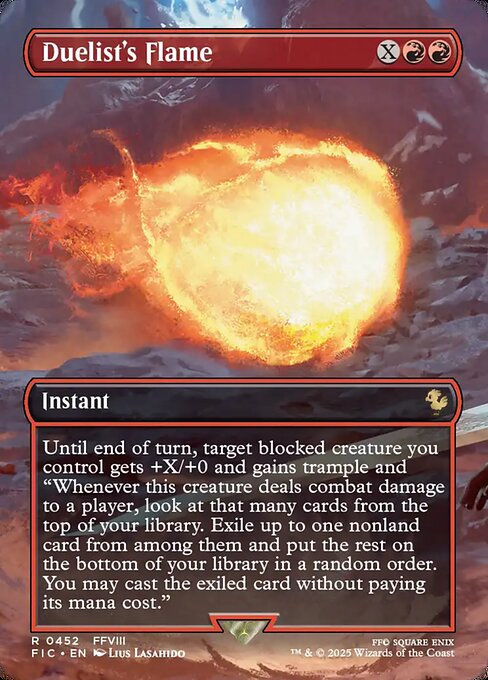
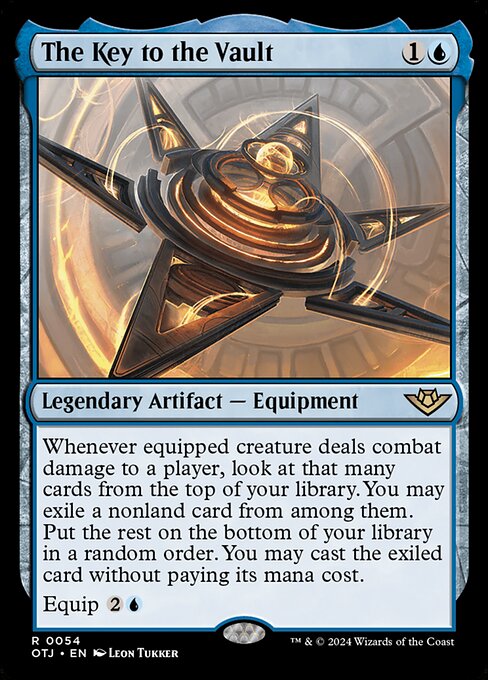
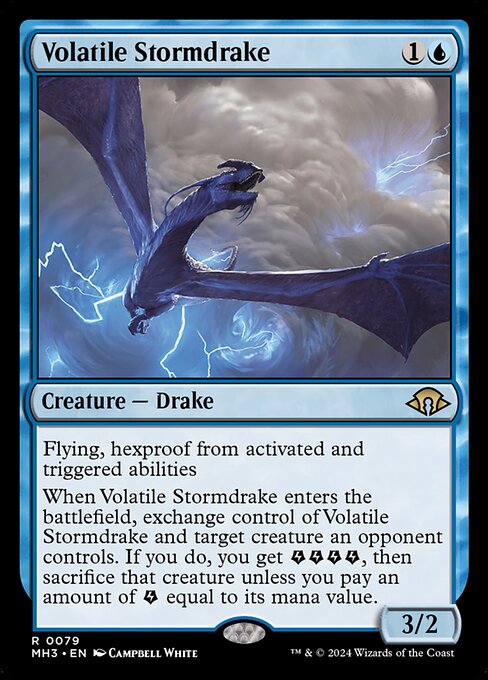
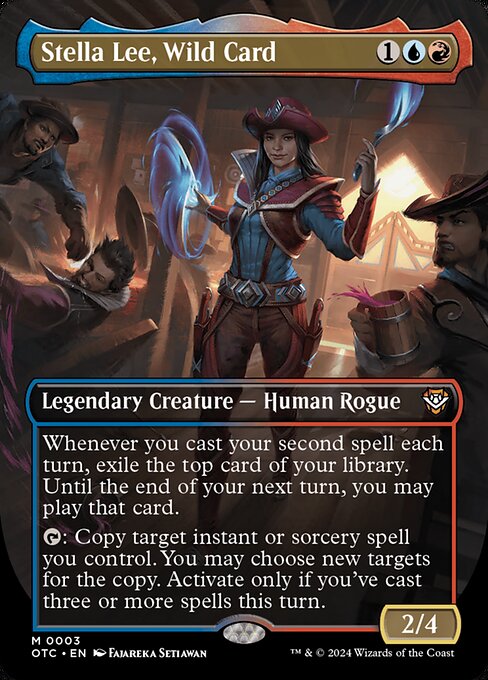
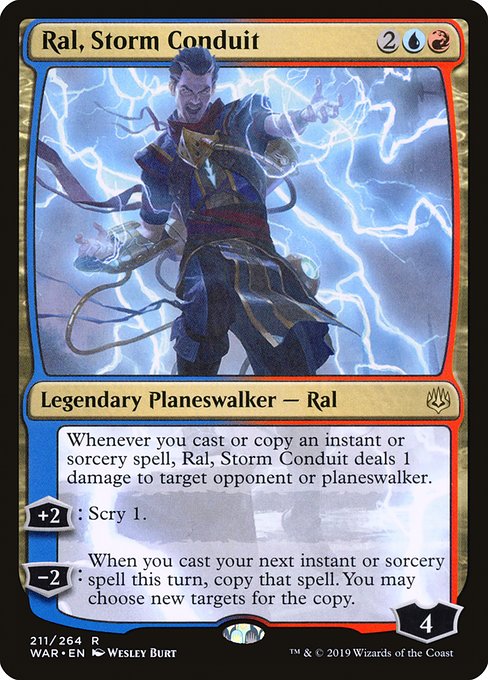
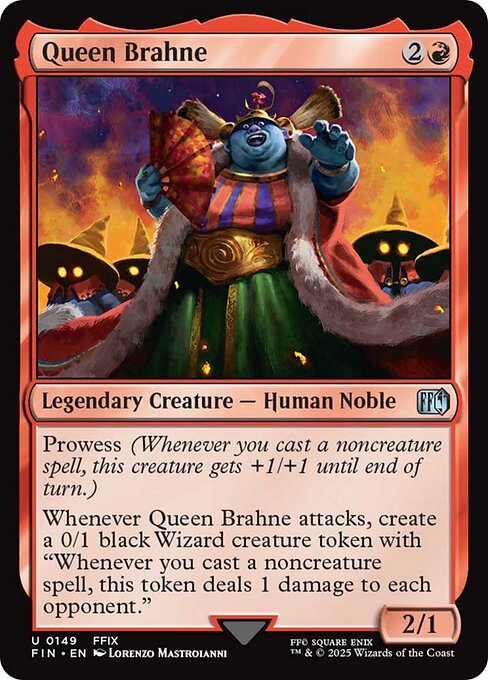
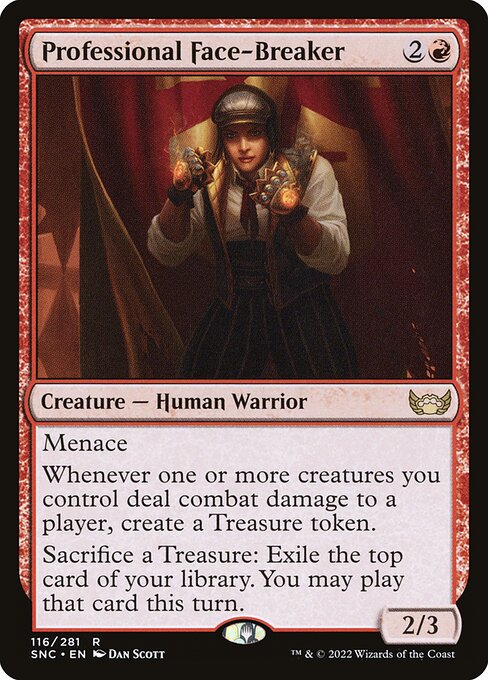
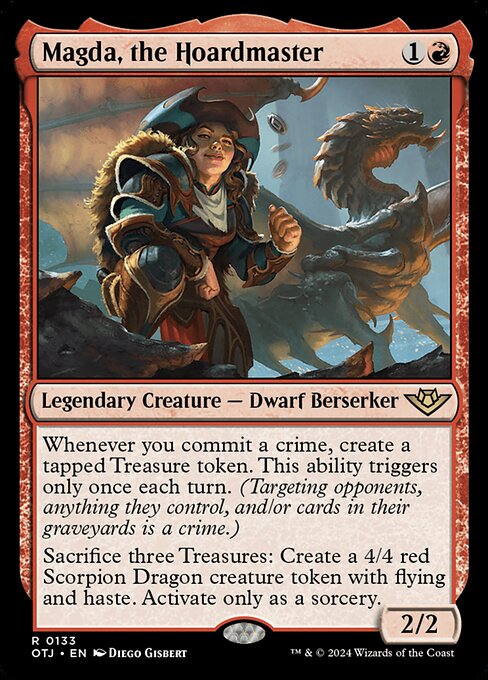
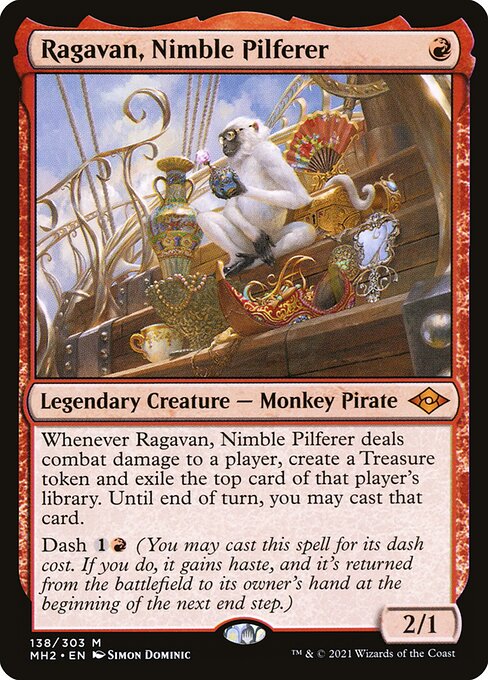
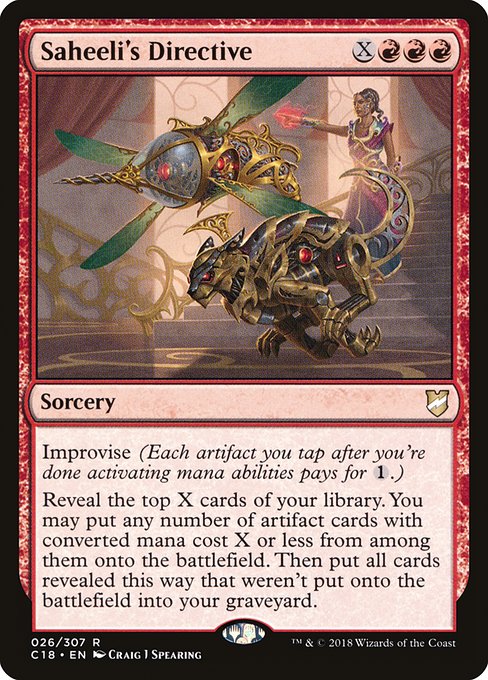
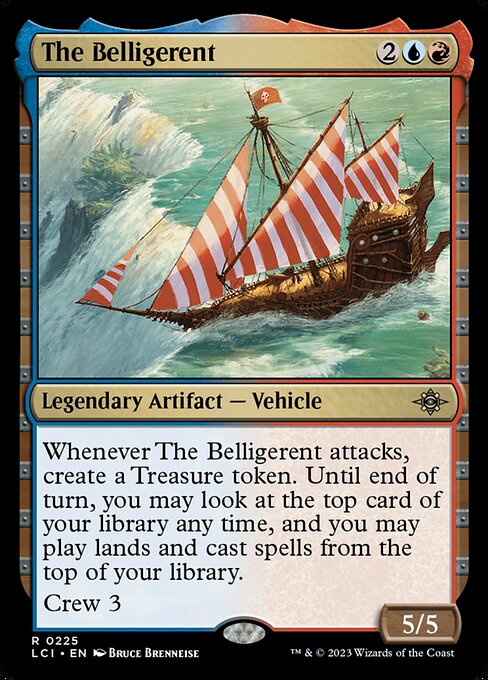
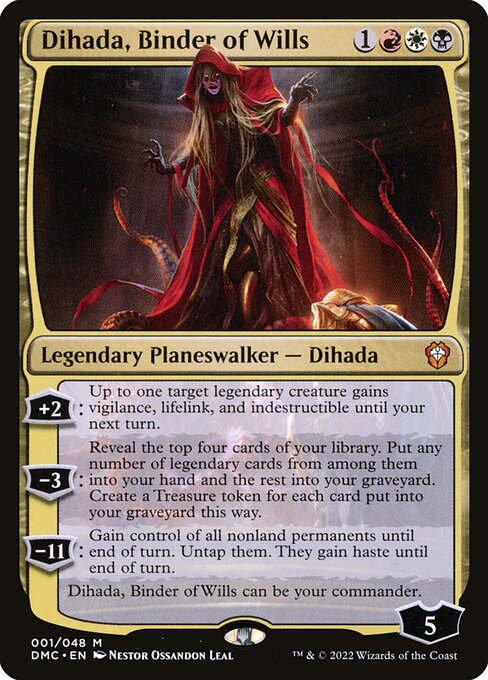
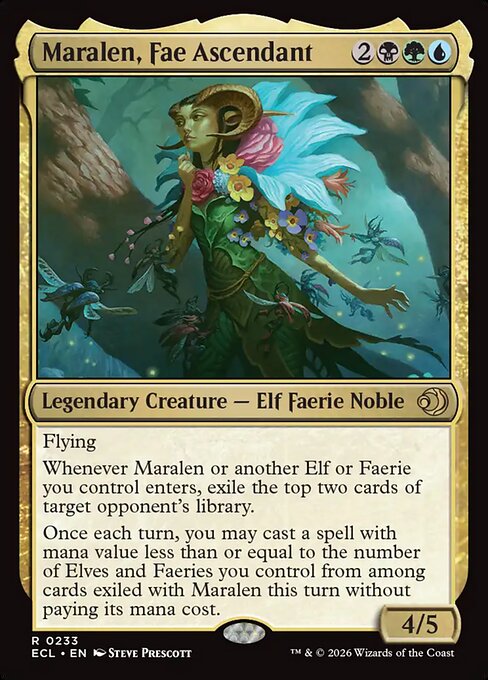
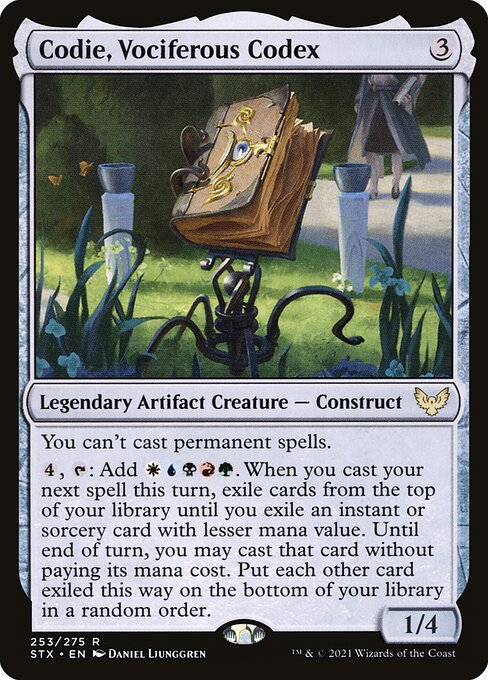
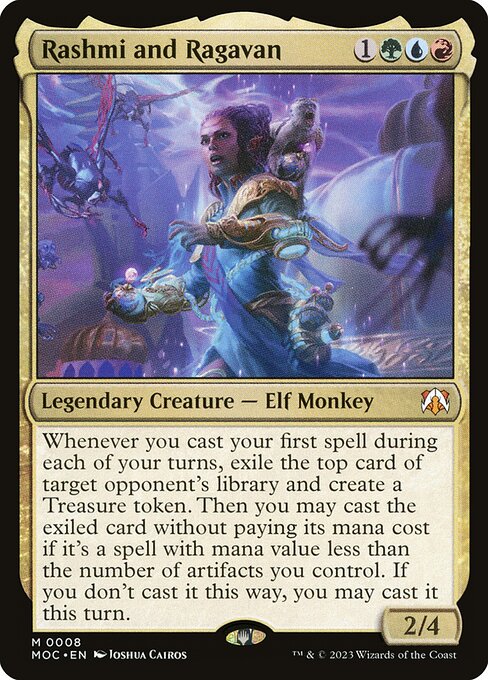
Rashmi and Ragavan wants a deck that steals its opponents' creatures and spells. It also suits a deck that casts lots of instant and sorcery spells.
Mana cost
Blue, Red, Green ()
Power / toughness2 / 4
RarityMythic
Whenever you cast your first spell during each of your turns, exile the top card of target opponent's library and create a Treasure token. Then you may cast the exiled card without paying its mana cost if it's a spell with mana value less than the number of artifacts you control. If you don't cast it this way, you may cast it this turn.
Picked for what they do in Rashmi and Ragavan's deck. When two cards do the same job, the one with the lower comes first. All of them fit Rashmi and Ragavan's color identity.Mana ValueThe total amount of mana a card costs, all added up. A card costing two generic and one green has a mana value of three. Wizards renamed this from "converted mana cost" in 2021, so older cards and articles may still use the old name.Open the full glossary
explain how Rashmi and Ragavan works in tricky situations. They come from Wizards of the Coast, the company that makes Magic.RulingThe official answer to how a card works in a tricky situation. Most rulings are written by Wizards of the Coast, the company that makes Magic, and a few are notes from Scryfall, the card database Magic players use. A ruling explains a card. It does not change what the card says.Open the full glossary
Wizards of the Coast14 Apr 2023
Check the number of artifacts you control as the ability resolves, including the Treasure token you just created, to see if you can cast the exiled card without paying its mana cost.
Wizards of the Coast14 Apr 2023
If the spell has {X} in its mana cost, you must choose 0 as the value of X when casting it without paying its mana cost.
Wizards of the Coast14 Apr 2023
If you cast a spell without paying its mana cost, you can’t choose to cast it for any alternative costs. You can, however, pay any additional costs. If the spell has any mandatory additional costs, you must pay those.
Wizards of the Coast14 Apr 2023
If you cast the spell without paying its mana cost, you do so during the resolution of the triggered ability. Timing restrictions of that spell based on card type are ignored. It will resolve before the spell that caused the ability to trigger.
Wizards of the Coast14 Apr 2023
If you don’t cast it without paying its mana cost but rather cast it later in the turn, you must pay its costs, and you must follow all applicable timing rules. For example, if the card is a creature card, you can cast that card by paying its mana cost only during your main phase while the stack is empty.
Wizards of the Coast14 Apr 2023
If you don’t cast the card at all, it remains exiled.
Wizards of the Coast14 Apr 2023
Rashmi and Ragavan has to be on the battlefield at the moment you cast your first spell. Notably, on the turn you cast Rashmi and Ragavan, the ability won’t trigger for you that turn. If a spell causes Rashmi and Ragavan to leave the battlefield as an additional cost to cast it, the ability won’t trigger.
Wizards of the Coast14 Apr 2023
Rashmi and Ragavan’s ability resolves before the spell that caused it to trigger, but not before you have to pay for the original spell. You won’t be able to use the Treasure token you create to pay for it.
Color identityEvery color of mana symbol on a card, in its cost and in its rules text. Your commander's color identity sets the limit for your whole deck: every other card has to fit inside it. A deck led by a green and white commander cannot play a card with any blue in its color identity.Open the full glossaryURGPlayers write colors as letters: U for blue, R for red, G for green. Blue is U because B was already taken by black.TheftTheft decks take control of opponents' creatures and other cards, or cast spells from their decks, and use them against them. Some steals last one turn so you can attack with the borrowed creature; others are permanent.Open the Theft pageImpulse DrawExiles cards from the top of your library and lets you play them for a short time, usually only that turn. You have to use them or lose them. Act on Impulse Prosper, Tome-BoundOpen the Impulse Draw pageTheftTakes something that belongs to an opponent: a creature, another permanent, or even a spell cast straight off the top of their deck. Act of Treason, Hellkite TyrantOpen the Theft pageToken EngineMakes tokens again and again rather than once. A token is a creature or other permanent created by a card, with no card of its own. Something that makes one token gives you a body; something that makes them every turn gives you a board you can keep rebuilding after it is cleared. Grave Titan, Bitterblossom, OphiomancerOpen the Token Engine pageDrawDraws you extra cards. More cards means more choices every turn, and in a 100-card deck it is the main way to find the pieces you need. Rhystic Study, SkullclampOpen the Draw pageSpellslingerSpellslinger decks cast lots of instants and sorceries, one-time spells, and play creatures that reward every spell you cast. Instants and sorceries take effect once and then go to your graveyard, and an instant can even be cast during another player's turn.Open the Spellslinger pageSpellslinger PayoffRewards you specifically for casting or copying instants and sorceries, usually with a trigger each time. Narrower than Spellslinger, which covers the whole instant-and-sorcery family. Archmage Emeritus, Storm-Kiln ArtistOpen the Spellslinger Payoff pageTreasure EngineProduces Treasure tokens repeatedly. A Treasure is a small artifact token you sacrifice for one mana of any color. Something that keeps making them is mana acceleration and, at the same time, a steady supply of artifacts to sacrifice for anything that wants them. Smothering Tithe, Dockside Extortionist, Goldspan DragonOpen the Treasure Engine pageCard SelectionImproves what you draw rather than how much: you look at the top few cards of your library and decide what stays on top. Ponder lets you rearrange the top three, Serum Visions lets you scry, and Consider lets you surveil. It makes your draws more reliable without giving you extra cards.Open the Card Selection pageFree CastCan be cast without paying its mana cost when a condition is met, often "if you control your commander". Because it costs nothing, you can still answer something after your mana is already spent. Fierce Guardianship, Deflecting SwatOpen the Free Cast pageTreasuresTreasure decks make lots of Treasures, small artifact tokens you can trade in for one mana of any color, then spend that mana on big plays. Many of the same cards reward you for having or sacrificing artifacts, so each Treasure does two jobs.Open the Treasures pageTreasureCreates or cares about Treasure tokens: small artifacts you can sacrifice for one mana of any color. Saving them up lets you cast something big early, or feed anything that likes sacrificing artifacts.Open the Treasure pageLibrary ManipulationCards that let you look at, rearrange or play from the top of your deck, so you control what you draw next.Open the Library Manipulation pageArtifact PayoffRewards you for having artifacts: counting them, triggering off them, or getting cheaper as you play more. Urza's Saga, Mox OpalOpen the Artifact Payoff page
Send Us Feedback
What works, what's confusing, what you wish the site did. We read every one.
Not signed in? That is fine. We only keep what you write.
Optional. We only use it to reply to you.
Can we use Google Analytics cookies?
They show us which pages help people. No ads.
Privacy Policy


 Open the full glossary