- Commander Nexus
- Commanders
- Aang, Swift Savior // Aang and La, Ocean's Fury
Command zone

Aang, Swift Savior // Aang and La, Ocean's Fury
Legendary Creature — Human Avatar Ally // Legendary Creature — Avatar Spirit Ally
Aang wants a deck that sends cards back to their owners' hands. It also suits a deck that keeps making its creatures bigger turn after turn.
- Mana cost


- White, Blue ()
- Power / toughness2 / 3
- RarityRare
Flash
Flying
When Aang enters, airbend up to one other target creature or spell. (Exile it. While it's exiled, its owner may cast it for  rather than its mana cost.)
Waterbend  : Transform Aang.
//
Reach, trample
Whenever Aang and La attack, put a +1/+1 counter on each tapped creature you control.
Build a deck with Aang Find it in the app
- Archetypes
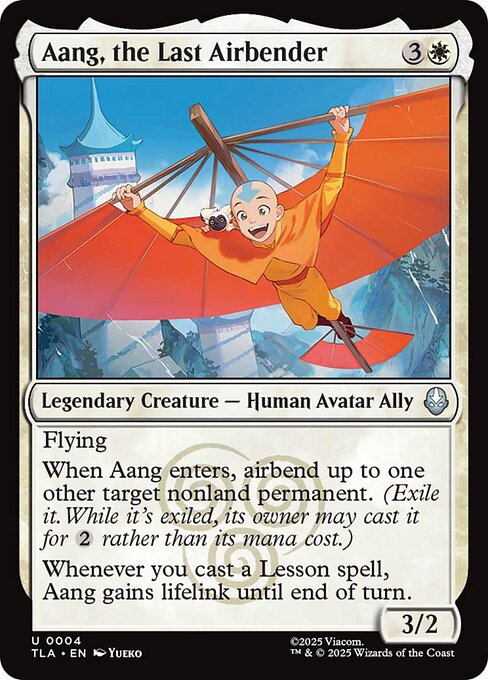
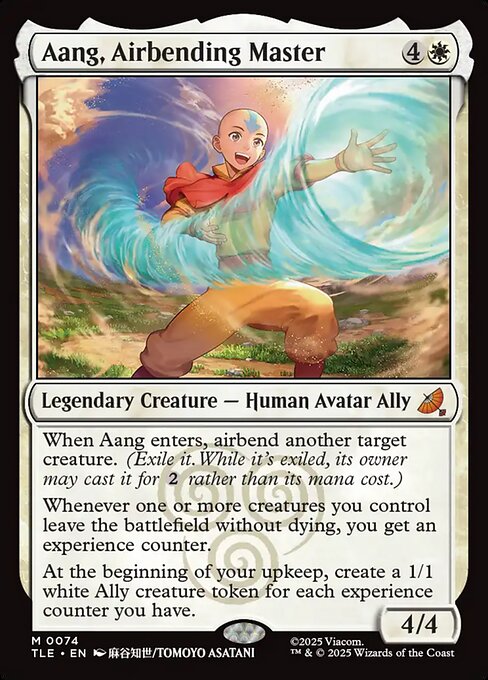
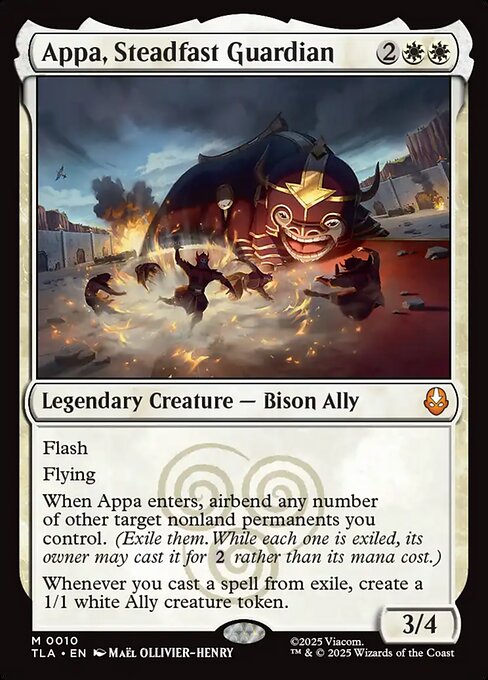
Cards That Fit Aang, Swift Savior
Picked for what they do in Aang's deck. When two cards do the same job, the one with the lower comes first. All of them fit Aang's color identity.Mana ValueThe total amount of mana a card costs, all added up. A card costing two generic and one green has a mana value of three. Wizards renamed this from "converted mana cost" in 2021, so older cards and articles may still use the old name. Open the full glossary
plan6


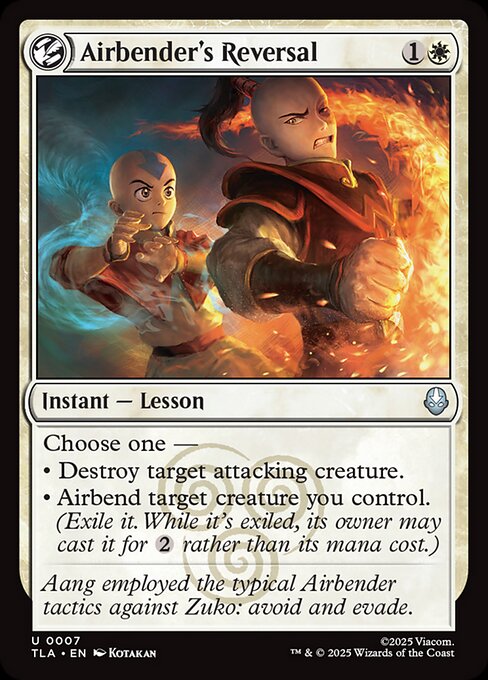
plan6


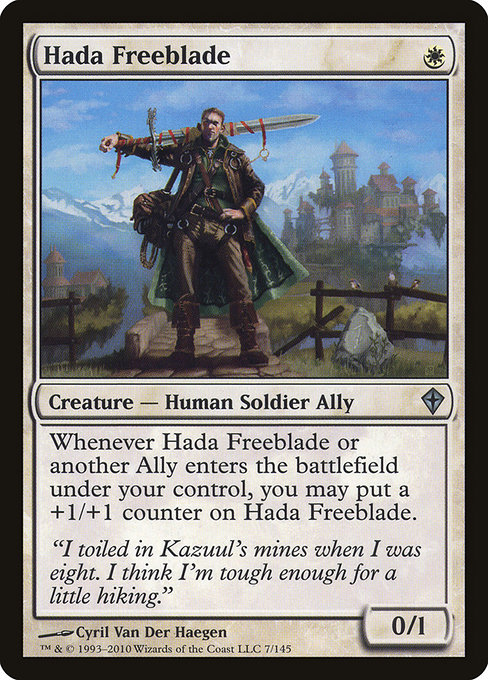


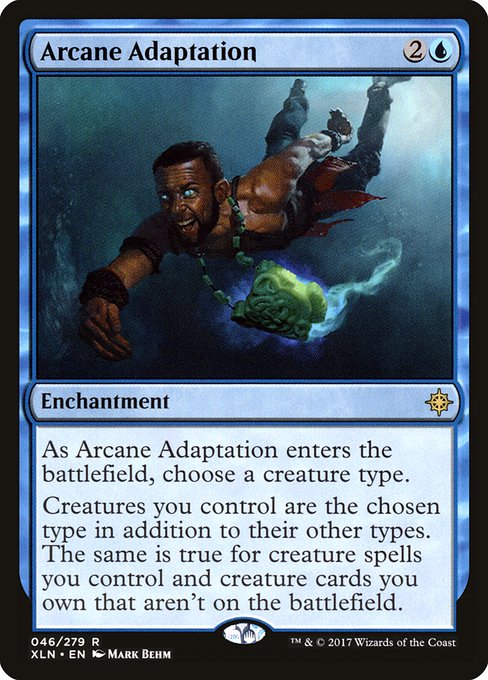

Rulings for Aang, Swift Savior
explain how Aang works in tricky situations. They come from Wizards of the Coast, the company that makes Magic.RulingThe official answer to how a card works in a tricky situation. Most rulings are written by Wizards of the Coast, the company that makes Magic, and a few are notes from Scryfall, the card database Magic players use. A ruling explains a card. It does not change what the card says.Open the full glossary
"Waterbend [cost]" means "Pay [cost]. For each generic mana in that cost, you may tap an untapped artifact or creature you control rather than pay that mana."
Even if the cost of the spell or ability that waterbend is part of increases or decreases, you still may only tap artifacts or creatures to pay for costs up to the amount of the generic mana in the waterbend cost.
If a spell is exiled this way, it's removed from the stack and thus will not resolve. The spell isn't countered; it is exiled. This works against a spell that can't be countered.
If a waterbend cost is part of the total cost to cast a spell or activate an ability, you may tap an untapped artifact or creature you control rather than pay one generic mana in that total cost any number of times up to a maximum of the amount of generic mana in the waterbend component of that total cost.
If an artifact or creature you control has a mana ability with {T} in the cost, activating that ability while casting a spell or activating an ability with waterbend will result in the artifact or creature being tapped before you pay the spell's costs. You won't be able to tap it again for waterbend. Similarly, if you sacrifice an artifact or creature to activate a mana ability to pay a cost with waterbend, that artifact or creature won't be on the battlefield when you pay the spell's costs, so you won't be able to tap it for waterbend.
If the spell you cast has {X} in its mana cost, you must choose 0 as the value of X.
Lands exiled this way cannot be played from exile. (Lands that were animated by earthbend will be returned to the battlefield tapped when they're exiled.)
Since you are using an alternative cost to cast a spell from exile this way, you can't pay any other alternative costs. You can, however, pay additional costs, such as kicker costs. If the card has any mandatory additional costs, you must pay those.
To airbend one or more permanents and/or spells means to exile each of those objects. For each card exiled this way, for as long as it's exiled, its owner may cast it from exile by paying {2} rather than paying its mana cost.
Tokens exiled this way will cease to exist and cannot be cast.
You can tap any untapped creature or artifact you control to pay a waterbend cost, even one you haven't controlled continuously since the beginning of your most recent turn.
11 rulings, all written by Wizards of the Coast. Read the originals on Gatherer ↗
Similar Commanders
Commanders that share the most with Aang, and what they share.