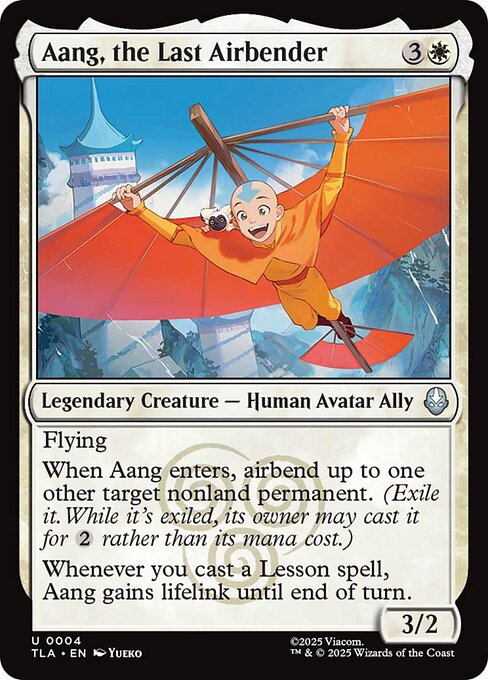
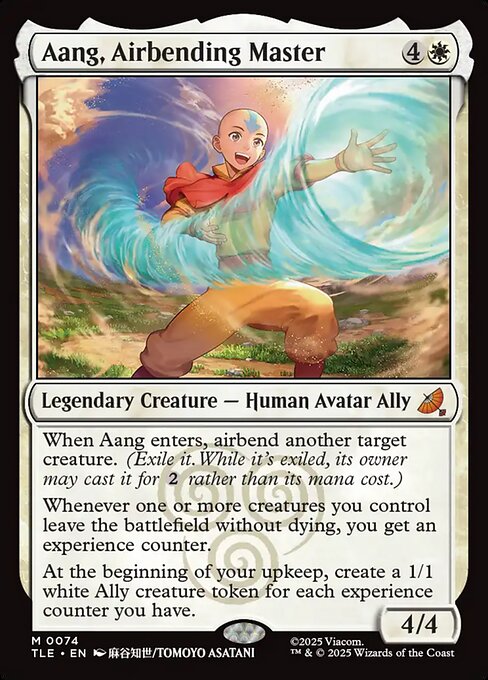
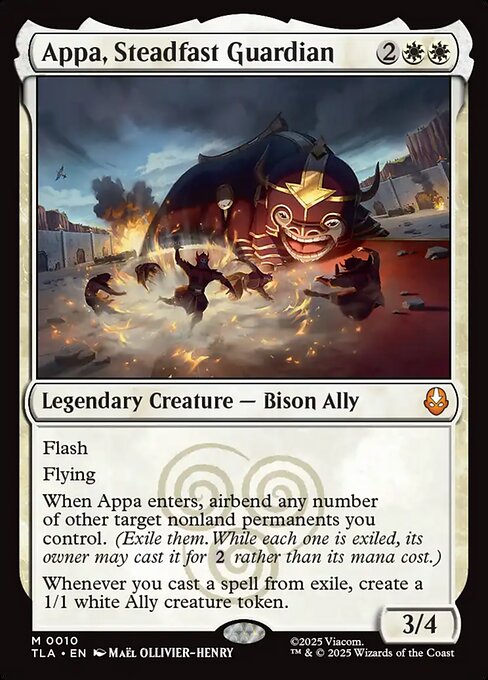
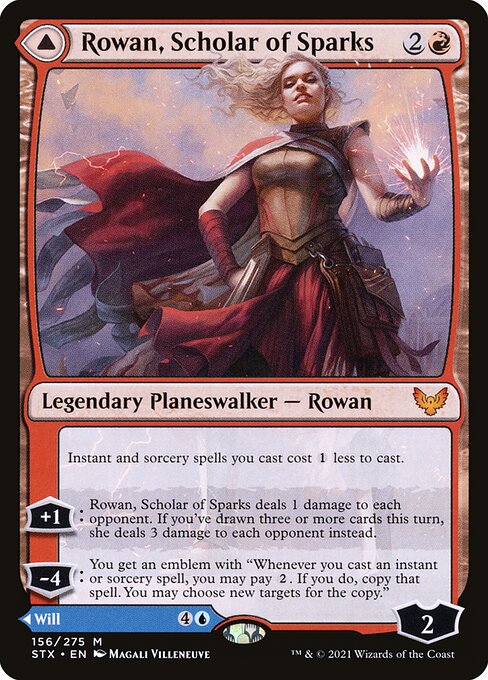
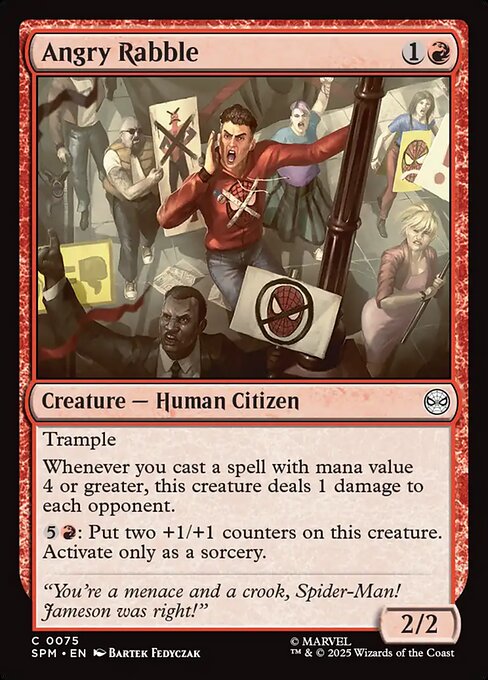
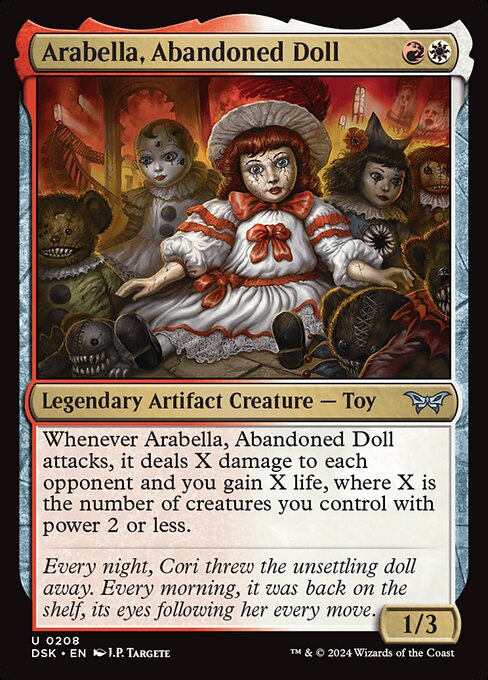
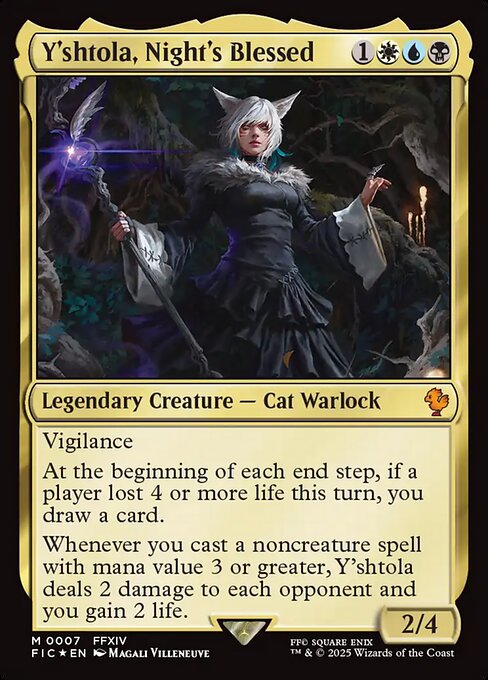
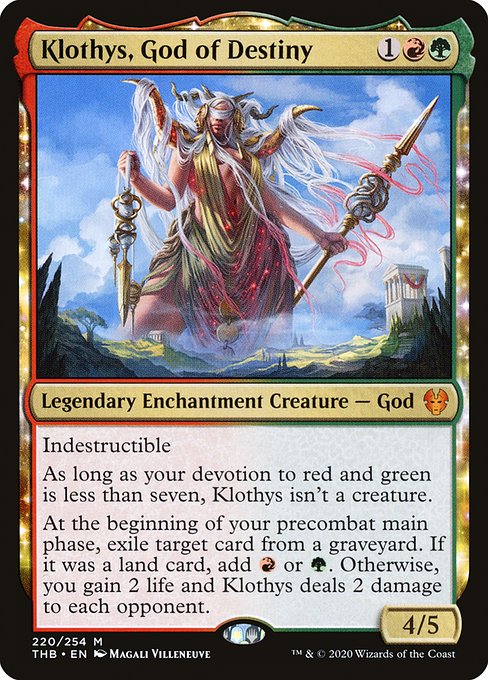
Avatar Aang wants a deck that sends cards back to their owners' hands. It also suits a deck that hurts every player at once and outlasts the pain.
Mana cost
All five colors ()
Power / toughness4 / 4
RarityMythic
Flying, firebending 2
Whenever you waterbend, earthbend, firebend, or airbend, draw a card. Then if you've done all four this turn, transform Avatar Aang.
//
Flying
Spells you cast cost less to cast. (This can reduce generic costs.)
At the beginning of each upkeep, you may transform Aang, Master of Elements. If you do, you gain 4 life, draw four cards, put four +1/+1 counters on him, and he deals 4 damage to each opponent.
Picked for what they do in Avatar Aang's deck. When two cards do the same job, the one with the lower comes first. All of them fit Avatar Aang's color identity.Mana ValueThe total amount of mana a card costs, all added up. A card costing two generic and one green has a mana value of three. Wizards renamed this from "converted mana cost" in 2021, so older cards and articles may still use the old name.Open the full glossary
explain how Avatar Aang works in tricky situations. They come from Wizards of the Coast, the company that makes Magic.RulingThe official answer to how a card works in a tricky situation. Most rulings are written by Wizards of the Coast, the company that makes Magic, and a few are notes from Scryfall, the card database Magic players use. A ruling explains a card. It does not change what the card says.Open the full glossary
Wizards of the Coast2 Oct 2025
"Firebending N" is a keyword that represents the ability "Whenever this creature attacks, add N {R}. Until end of combat, you don't lose this mana as steps end."
Wizards of the Coast2 Oct 2025
An ability that triggers "whenever you airbend" triggers after the process described by the airbend keyword action is complete, even if some or all of the actions were impossible.
Wizards of the Coast2 Oct 2025
An ability that triggers "whenever you earthbend" triggers immediately after the list of actions earthbend entails is complete, even if some or all of those actions were impossible, perhaps because an effect does not allow counters to be placed on creatures you control.
Wizards of the Coast2 Oct 2025
An ability that triggers "whenever you firebend" triggers whenever a firebending ability you control resolves.
Wizards of the Coast2 Oct 2025
An ability that triggers "whenever you waterbend" triggers whenever you pay a waterbend cost, regardless of how you paid that cost. You do not have to tap artifacts or creatures to help pay the cost for the ability to trigger.
Wizards of the Coast2 Oct 2025
Any other mana you add during combat will still be lost as normal when moving between steps of combat.
Wizards of the Coast2 Oct 2025
Avatar Aang's last ability looks at the whole turn when determining whether or not Avatar Aang should transform, not just actions you've taken since he entered or came under your control. For example, say you airbend, waterbend, and earthbend, then play Avatar Aang. If you firebend later in the turn, then when Avatar Aang's ability resolves, he'll transform since you've done all four this turn.
Wizards of the Coast2 Oct 2025
Firebending abilities aren't mana abilities. They use the stack and can be responded to.
Wizards of the Coast2 Oct 2025
Mana from firebending abilities isn't lost until you leave combat and go to your second main phase. It can be used at any time during combat, even after combat damage has been dealt.
Wizards of the Coast2 Oct 2025
Multiple instances of firebending on the same creature trigger separately, each granting you the appropriate amount of mana.
Wizards of the Coast2 Oct 2025
To determine the total cost of a spell, start with the mana cost or alternative cost you're paying, add any cost increases, then apply any cost reductions. The mana value of the spell remains unchanged, no matter what the total cost to cast it was.
Color identityEvery color of mana symbol on a card, in its cost and in its rules text. Your commander's color identity sets the limit for your whole deck: every other card has to fit inside it. A deck led by a green and white commander cannot play a card with any blue in its color identity.Open the full glossaryWUBRGPlayers write colors as letters: W for white, U for blue, B for black, R for red, G for green. Blue is U because B was already taken by black.BounceBounce decks send cards on the battlefield back to their owner's hand, to slow opponents down or to reuse their own cards. Bouncing an opponent's card makes them pay for it again; bouncing your own lets its 'when this enters' ability happen twice.Open the Bounce pageAirbendAirbend sends a permanent or a spell into exile, out of the game for now. Its owner can cast it again later, but only by paying 2 mana instead of its normal cost.Open the Airbend pageCounter EngineAdds +1/+1 counters over and over rather than once. A counter here is a small permanent marker that raises a creature's power and toughness for good. It is not a counterspell, which is a different thing entirely. Something that adds them every turn makes your whole board bigger and keeps it that way. Hardened Scales, Corpsejack MenaceOpen the Counter Engine pageEvasionAn ability that makes a creature hard to block, so its attacks reach the player. Flying, menace, landwalk and plain 'can't be blocked' are the common kinds.Open the Evasion pageDrawDraws you extra cards. More cards means more choices every turn, and in a 100-card deck it is the main way to find the pieces you need. Rhystic Study, SkullclampOpen the Draw pageGroup SlugGroup Slug decks hurt every player at the table at once, then make sure they can survive the pain better than anyone else. Typical cards make each player take damage or lose life whenever they draw, cast a spell or tap a land for mana.Open the Group Slug pageMass BurnDeals damage to everything, or to every opponent at once, rather than to a single target. In a four player game the same card hits three people, so small repeated amounts add up quickly. Blasphemous Act, Impact TremorsOpen the Mass Burn pageCost ModificationChanges what a spell costs to cast: cheaper for you, or more expensive for everyone. It is the broad family; Cost Reducer and Spell Tax say which direction a given card goes. Herald's Horn, Foundry InspectorOpen the Cost Modification pageRepeatable DamageDeals damage again and again rather than once. It comes from an activated ability you can use every turn, or a trigger that fires whenever something happens. Walking Ballista, Impact TremorsOpen the Repeatable Damage pageBurnDeals damage directly, to creatures or to players. Because it can hit a player as easily as a creature, the same card can remove a blocker or finish off an opponent. Lightning Bolt, Blasphemous ActOpen the Burn pageLifegain EngineGains you life again and again, on a trigger that keeps happening, rather than once. You start at 40 life in Commander, so life is something to spend as well as a cushion, and a card like this sets off every card that rewards you for gaining it. Soul Warden, Trostani, Selesnya's VoiceOpen the Lifegain Engine pageBurnBurn decks win by dealing damage straight to opponents with spells and abilities, rather than by attacking with creatures. Damage that hits every opponent at once counts three times over at a four-player table.Open the Burn page
Send Us Feedback
What works, what's confusing, what you wish the site did. We read every one.
Not signed in? That is fine. We only keep what you write.
Optional. We only use it to reply to you.
Can we use Google Analytics cookies?
They show us which pages help people. No ads.
Privacy Policy


 Open the full glossary