Farid wants a deck that sacrifices its own creatures to drain opponents' life. It also suits a deck that gives up its own cards on purpose to get something back.
Mana cost
Red ()
Power / toughness3 / 3
RarityRare
Whenever a nontoken artifact you control is put into a graveyard from the battlefield, create a colorless artifact token named Scrap.
, Sacrifice an artifact: Choose one —
• Put a +1/+1 counter on Farid. It gains menace until end of turn.
Picked for what they do in Farid's deck. When two cards do the same job, the one with the lower comes first. All of them fit Farid's color identity.Mana ValueThe total amount of mana a card costs, all added up. A card costing two generic and one green has a mana value of three. Wizards renamed this from "converted mana cost" in 2021, so older cards and articles may still use the old name.Open the full glossary
explain how Farid works in tricky situations. They come from Wizards of the Coast, the company that makes Magic.RulingThe official answer to how a card works in a tricky situation. Most rulings are written by Wizards of the Coast, the company that makes Magic, and a few are notes from Scryfall, the card database Magic players use. A ruling explains a card. It does not change what the card says.Open the full glossary
Wizards of the Coast14 Oct 2022
The token's name is Scrap, and it has no abilities.
Wizards of the Coast30 Jun 2023
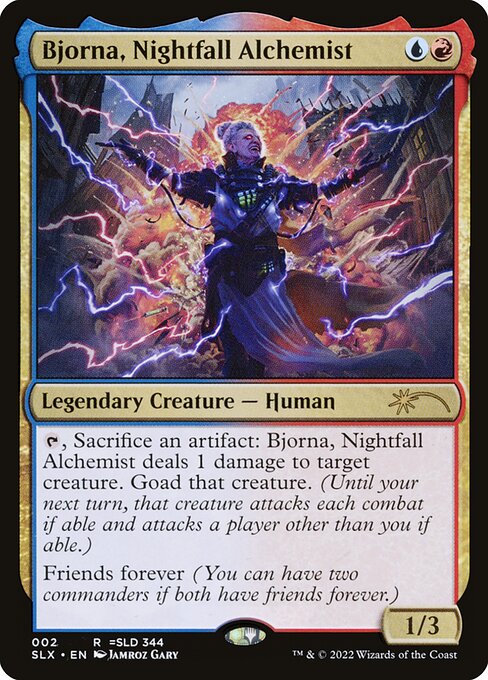
Attacking with a goaded creature doesn't cause it to stop being goaded. If there is an additional combat phase that turn, or if another player gains control of it before it stops being goaded, it must attack again if able.
Wizards of the Coast30 Jun 2023
Being goaded isn't an ability the creature has. Once it's been goaded, it must attack as detailed above even if it loses all abilities.
Wizards of the Coast30 Jun 2023
If a creature you control has been goaded by multiple opponents, it must attack one of your opponents that hasn't goaded it, as that fulfills the maximum number of goad requirements. If a creature you control has been goaded by each of your opponents, the creature must attack an opponent (rather than a planeswalker or battle), but you choose which opponent it attacks.
Wizards of the Coast30 Jun 2023
If the creature doesn't meet any of the above exceptions and can attack, it must attack a player other than the controller of the spell or ability that goaded it if able. If the creature can't attack any of those players but could otherwise attack, it must attack a planeswalker an opponent controls, a battle an opponent controls, or a player who goaded it.
Wizards of the Coast30 Jun 2023
If, during a player's declare attackers step, a creature that player controls that's been goaded is tapped, is affected by a spell or ability that says it can't attack, or hasn't been under that player's control continuously since the turn began (and doesn't have haste), then it doesn't attack. If there's a cost associated with having a creature attack a player, its controller isn't forced to pay that cost, so it doesn't have to attack that player.
Color identityEvery color of mana symbol on a card, in its cost and in its rules text. Your commander's color identity sets the limit for your whole deck: every other card has to fit inside it. A deck led by a green and white commander cannot play a card with any blue in its color identity.Open the full glossaryRPlayers write colors as letters: R for red.AristocratsAristocrats decks sacrifice their own creatures on purpose and profit every time one dies, often by draining life from each opponent. A sacrifice outlet, a card that lets you sacrifice whenever you like, decides when that happens.Open the Aristocrats pageArtifact PayoffRewards you for having artifacts: counting them, triggering off them, or getting cheaper as you play more. Urza's Saga, Mox OpalOpen the Artifact Payoff pageSacrifice OutletA permanent that lets you sacrifice your own creatures or artifacts whenever you want, usually for free. Every Aristocrats deck needs one, because cards that reward a creature dying only help if you choose when it dies. Ashnod's Altar, Viscera SeerOpen the Sacrifice Outlet pageForced CombatForces creatures to attack, or decides who they attack, often with goad. In multiplayer it points other people's creatures at each other instead of at you. Bident of Thassa, Toski, Bearer of SecretsOpen the Forced Combat pageDeath TriggerTriggers when a creature dies, whether it is this creature, one of yours or an opponent's. These are the cards that pay you in an Aristocrats deck: something else makes creatures die, and these decide what you get each time. Blood Artist, Solemn SimulacrumOpen the Death Trigger pageSacrificeSacrifice decks give up their own creatures, Treasures and other cards on purpose and get something back each time. A sacrifice outlet, a card that lets you sacrifice whenever you want, is the heart of the deck.Open the Sacrifice pageToken EngineMakes tokens again and again rather than once. A token is a creature or other permanent created by a card, with no card of its own. Something that makes one token gives you a body; something that makes them every turn gives you a board you can keep rebuilding after it is cleared. Grave Titan, Bitterblossom, OphiomancerOpen the Token Engine pageToken MakerCreates one or more tokens. Different cards make very different ones: creatures Grave Titan, Treasures Smothering Tithe, Clues Tireless Tracker or Food Gilded Goose. This is one of our largest tags, so pair it with an archetype or theme when you are hunting a specific kind.Open the Token Maker pageMadness/DiscardDiscard decks throw away their own cards on purpose and play cards that reward each discard. Cards with madness can even be cast for a different, usually cheaper, cost at the moment you discard them.Open the Madness/Discard pageLootingDraws and discards in the same breath. Faithless Looting, Frantic Search. It does not gain you cards. It improves the ones you have, and fills your graveyard on purpose, which is exactly what a reanimator card like Animate Dead wants.Open the Looting pageSelf-DiscardDiscards your own cards as a cost or an effect. Filling your own graveyard on purpose is the point: it feeds cards that bring things back, madness and channel abilities, and some cards are worth more there than in hand. Faithless Looting, Boseiju, Who EnduresOpen the Self-Discard page
Send Us Feedback
What works, what's confusing, what you wish the site did. We read every one.
Not signed in? That is fine. We only keep what you write.
Optional. We only use it to reply to you.
Can we use Google Analytics cookies?
They show us which pages help people. No ads.
Privacy Policy


 Open the full glossary