
Cards that skip a turn and how it affects Commander Brackets
Some of the strongest, cheapest cards ask you to skip your next turn. Here's what that really costs you at a four-player table.
What "skip your next turn" means
Some cards end with the words "You skip your next turn." It means exactly what it says. When your next turn would start, it just doesn't happen, and play moves straight on to the next player.
You miss everything your turn normally gives you. You don't your cards, you don't draw, and you can't play a land. Anything you tapped stays tapped until the turn after that.
You're still in the game, though. On everyone else's turns you can still block, cast spells at and use abilities that don't need your own turn.
Why would anyone play these?
Because the payoff is huge for how little you pay. The skipped turn is the real price:
- Meditate costs three mana and draws you four cards.
- Chronatog
 can get +3/+3 for no mana at all. That's 3 more and 3 more until the end of the turn, and you can only do it once each turn.
- Eater of Days
 costs four mana for a huge creature: 9 , 8 , flying and . The catch is that you skip your next two turns.
What it costs at a four-player table
In a two-player game, skipping a turn hands your opponent two turns in a row. At a four-player Commander table it's a lot worse. The other three players each take two turns before you get your next one. That's six turns where your cards stay tapped and you can't draw or play a land.
That's what makes these cards incredibly risky. Your blockers have to survive two full trips around the table, and any lands you tapped for mana that turn stay tapped the whole time. Someone can also hit the card you paid for with before you ever get to use it. If you can, leave a few lands untapped so you have mana to protect it.
Getting the turn back
A few cards pay you back:
- Wormfang Manta
 makes you skip your next turn when it enters. When it leaves the battlefield, you take an extra turn.
- Magosi, the Waterveil
 lets you skip a turn now to put an eon on it, which saves that turn for later. When you want it back, you remove the marker and return Magosi to your hand to take an extra turn.
come with their own table etiquette. Wizards' rules say that in Brackets 2 and 3, extra-turn cards "should only appear in low quantities and are not intended to be chained in succession or looped." Chaining means taking them one after another. Our bracket check goes a step further and counts any extra turn card as a sign the deck is Bracket 2 or higher.
Stopping someone else's extra turn
Some cards turn somebody else's extra turn into a skipped one. Ugin's Nexus and Gerrard's Hourglass Pendant
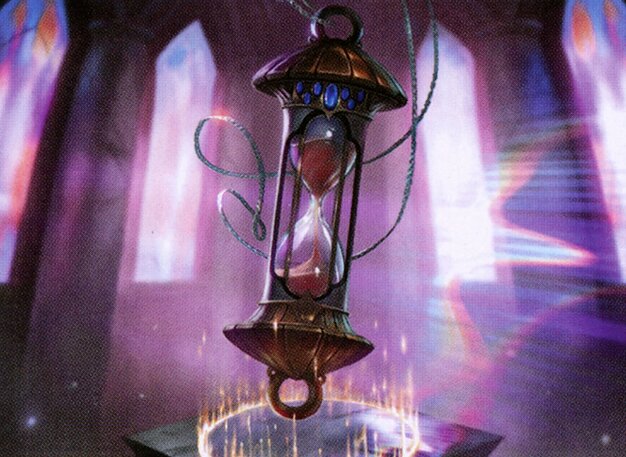 say that if a player would begin an extra turn, "that player skips that turn instead." Stranglehold
 does the same thing, but only to your opponents. They're a direct answer to decks built around cards like Time Warp
 .
Find more
We tag every card that skips part of a turn or a whole turn, so you can find them all in one place: Turn Skipping. Most of them skip your draw step, the part of your turn where you draw a card, not the whole turn. Always be sure to read the card before you add it. Cards that give you a whole extra turn are under Extra Turns.
UntapTurning a tapped card upright so it can be used again. Cards normally untap once per turn during your untap step, so an effect that untaps something early gives you a second use of it.Open the full glossaryInstant SpeedAble to be used at any time, including during an opponent's turn or in the middle of combat, as opposed to sorcery speed, which is only on your own turn before you attack.Open the full glossaryPowerThe first of the two numbers in a creature's bottom-right corner. It is how much damage that creature deals when it fights or attacks.Open the full glossaryToughnessThe second of the two numbers in a creature's bottom-right corner. It is how much damage the creature can take in a turn before it dies. A creature whose toughness reaches zero dies immediately.Open the full glossaryTrampleIf a creature with trample is blocked, damage beyond what is needed to destroy its blockers spills over to the defending player.Open the full glossarySpot RemovalSpells or abilities that destroy, exile, or bounce a single one of your opponents' cards.Open the full glossaryCounterTwo different things share this word. A counter is a small marker placed on a card, such as a +1/+1 counter. To counter a spell is to stop it resolving while it is still on the stack.Open the full glossaryExtra TurnsSpells that grant you an additional turn. CHAINING means casting them repeatedly so opponents never get a turn back.Open the full glossaryBracketA number from 1 to 5 describing how strong a Commander deck is meant to be, so everyone at the table can agree on a fair game before it starts. Bracket 1 is a deck built purely for fun and Bracket 5 is as competitive as it gets. It is Wizards of the Coast's own system, not ours.Open the full glossaryEvery Card in This Article
-
Meditate
- Cheapest today
-
$23.01 Tempest #76, regular Buy at TCGplayer
Prices checked October 30, 2026.
-
Chronatog
- Cheapest today
-
$7.08 Visions #28, regular Buy at TCGplayer
Prices checked October 30, 2026.
-
One Commander-legal combo uses this card.
- Chronatog + Devoted Druid + Volrath, the Shapestealer Infinite green mana
From Commander Spellbook.
-
Eater of Days
- Cheapest today
-
$0.96 Darksteel #120, regular Buy at TCGplayer
Prices checked October 30, 2026.
-
One Commander-legal combo uses this card.
- Eater of Days + Fractured Identity + Oath of Teferi + Overwhelming Splendor + Tamiyo, Collector of Tales Near-infinite turns
From Commander Spellbook.
-
Wormfang Manta
- Bracket flags
,
- Cheapest today
-
$0.48 Judgment #58, regular Buy at TCGplayer
Prices checked October 30, 2026.
-
302 Commander-legal combos use this card.
- Scroll of Fate + Umbilicus + Wormfang Manta Infinite turns
- Hushwing Gryff + Mirage Phalanx + Wormfang Manta Infinite turns
- Mirage Phalanx + Tocatli Honor Guard + Wormfang Manta Infinite turns
From Commander Spellbook.
-
Magosi, the Waterveil
- Bracket flags
- Cheapest today
-
$1.05 Zendikar #218, regular Buy at TCGplayer
Prices checked October 30, 2026.
-
120 Commander-legal combos use this card.
- Gogo, Master of Mimicry + Magosi, the Waterveil Infinite turns
- Kiora's Follower + Lithoform Engine + Magosi, the Waterveil Infinite turns
- Kiora's Follower + Magosi, the Waterveil + Rings of Brighthearth Infinite turns
From Commander Spellbook.
- Commanders that want this card
-
- H.M.S. Bounty, Unlikely Timeship plan, shares
- Kang the Conqueror plan, shares ,
- Medomai the Ageless plan, shares
- Ultimecia, Time Sorceress // Ultimecia, Omnipotent plan, shares
-
Ugin's Nexus
- Bracket flags
,
- Cheapest today
-
$1.67 Khans of Tarkir #227, regular Buy at TCGplayer
Prices checked October 30, 2026.
-
348 Commander-legal combos use this card.
- Masterful Replication + Ugin's Nexus Near-infinite turns
- Drafna, Founder of Lat-Nam + Ugin's Nexus Infinite turns
- Mendicant Core, Guidelight + Meticulous Excavation + Ugin's Nexus Infinite turns
From Commander Spellbook.
- Commanders that want this card
-
- Emrakul, the Aeons Torn plan, shares
- Emrakul, the Promised End plan, shares
- Yosei, the Morning Star shares ,
-
Gerrard's Hourglass Pendant
- Cheapest today
-
$2.03 Dominaria United Commander #17, regular Buy at TCGplayer
Prices checked October 30, 2026.
- Commanders that want this card
-
- Hakim, Loreweaver shares ,
- Mister Immortal shares ,
- Obeka, Brute Chronologist shares
- Othelm, Sigardian Outcast shares ,
- Tameshi, Reality Architect shares ,
and 2 more.
-
Stranglehold
- Cheapest today
-
$6.60 Secret Lair Drop #1804, foil Buy at TCGplayer
Prices checked October 30, 2026.
-
5 Commander-legal combos use this card.
- Maralen of the Mornsong + Stranglehold Opponents can't search libraries
- Mornsong Aria + Stranglehold Lock
- Eternal Dominion + Eye of the Storm + Hive Mind + Stranglehold Opponents can't cast spells
From Commander Spellbook.
-
Time Warp
- Cheapest today
-
$7.08 Marvel Super Heroes Commander #788, regular Buy at TCGplayer
Prices checked October 30, 2026.
-
406 Commander-legal combos use this card.
- Charmbreaker Devils + Time Warp Infinite turns
- Panoptic Mirror + Time Warp Infinite turns
- Charnelhoard Wurm + Time Warp Infinite turns
From Commander Spellbook.
Read Next
-
 Guide
How much does a Commander deck cost to build?
A ready-made deck is usually always the cheapest way in. After that, most cards cost less than a dollar, and the more pricey ones are optional.
-
 Guide
Are Attractions legal in Commander?
Most are! The ones that are not all carry a small symbol, and this guide shows how to spot it.
-
 Guide
Can this card be your commander?
Most commanders are legendary creatures, though there are exceptions to every rule. A few other types of cards can lead a deck too.