
Can this card be your commander?
Most commanders are legendary creatures, though there are exceptions to every rule. A few other types of cards can lead a deck too.
The basic rule
In Commander, one card leads your deck. It starts the game in the , a space next to the battlefield, and you can cast it from there (rules 903.6 and 903.8).
Generally speaking, a card can be your commander if it is and it is a creature. Check the type line, which is the line of text across the middle of the card that says what kind of card it is. If it says both "Legendary" and "Creature", as in "Legendary Creature" or "Legendary Artifact Creature", the card can lead your deck as a commander.
Rule 903.3 allows two more kinds of legendary card: a Vehicle, and a Spacecraft with a and box printed on it. This same ruling allows a few other cards that say "can be your commander" in their own text.
Your chosen commander(s) also limits the colors of every other card in your deck. Each card has a : the colors of every mana symbol on it, including any in its rules text. Every card in your deck has to fit inside your commander's color identity (rules 903.4 and 903.5c).
Vehicles and Spacecraft
A Vehicle is an artifact that can become a creature for a while, usually when you tap your creatures to it (rules 301.7 and 702.122a). The Lunar Whale is a legendary artifact with the Vehicle type, so it can be your commander.
A Spacecraft is another kind of artifact. It only counts if it has a power and toughness box, the two numbers in the bottom corner of the card. Hearthhull, the Worldseed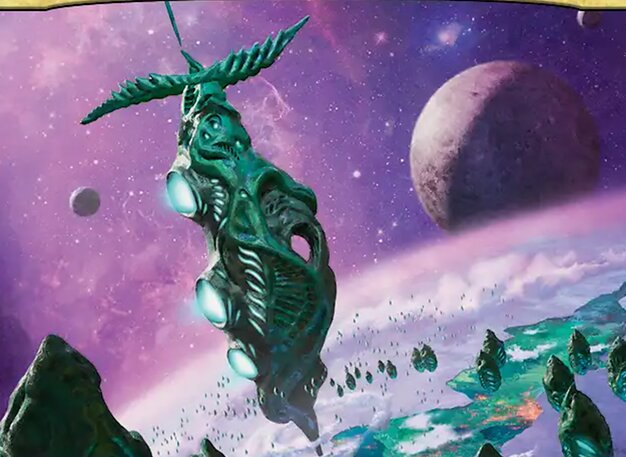 has one, so it qualifies. The Eternity Elevator
 has none, so it does not.
Planeswalkers that say so
A planeswalker is its own card type, not a creature, so most cannot lead a deck. A small group of them have an extra line that changes that. Daretti, Scrap Savant and Freyalise, Llanowar's Fury both end with "can be your commander."
On Oct 22, 2026, Scryfall listed 22 Commander-legal cards with that line, and every one of them is a legendary planeswalker.
Grist, the Hunger Tide is the odd one out. Its text says "As long as Grist isn't on the battlefield, it's a 1/1 Insect creature in addition to its other types." The official ruling on the card says this already works while you build your deck, so Grist can be your commander.
Two commanders at once
Some commanders let you pick a second one. These are called partner abilities (rule 702.124a). Rowan Kenrith says "Partner with Will Kenrith", so Will Kenrith
 and Rowan can lead one deck together.
"Choose a Background" works the same way (rule 702.124k). Wilson, Refined Grizzly can pair with a Background, a legendary enchantment such as Candlekeep Sage
 . A Background can never be your commander by itself. It can only lead alongside a commander that has "Choose a Background".
Double-faced cards: only the front counts
Some cards have a second face on the back. While you build your deck, and while it sits in your hand, your or the command zone, such a card has only its front face (rule 712.8a). So the front face decides whether it can lead your deck.
Invasion of Theros // Ephara, Ever-Sheltering has a Battle on the front, a card type that players attack. When it is defeated, you cast it again as Ephara, a legendary creature. The front is not a creature, so it cannot be your commander.
Elbrus, the Binding Blade // Withengar Unbound is the same. Its front, Elbrus, is a legendary , an artifact you attach to a creature. Only the back, Withengar Unbound, is a creature.
Legendary is not the same as legal
A legendary creature that is banned in Commander cannot be your commander, or be added anywhere in your deck. Griselbrand and Emrakul, the Aeons Torn
 are two examples.
Find more
Browse the commanders named here: Daretti, Scrap Savant, Grist, the Hunger Tide, The Lunar Whale, Hearthhull, the Worldseed and Wilson, Refined Grizzly.
In short, a legendary creature can lead your deck, and so can a few legendary Vehicles, Spacecraft and planeswalkers. Next, search any card in Discover and read its type line to see if it qualifies, or open one of these commander pages to see deck ideas and the cards that fit its colors.
Command ZoneThe area where your commander sits outside the game. It starts there, and returns there whenever it would die, be exiled, or go to your hand or deck. That is why neutralising a commander is often better than destroying it.Open the full glossaryLegendaryA word printed on some cards, as in Legendary Creature. Your commander is usually a legendary creature, and that is where the word matters most in Commander. Open the full glossaryPowerThe first of the two numbers in a creature's bottom-right corner. It is how much damage that creature deals when it fights or attacks.Open the full glossaryToughnessThe second of the two numbers in a creature's bottom-right corner. It is how much damage the creature can take in a turn before it dies. A creature whose toughness reaches zero dies immediately.Open the full glossaryColor IdentityEvery color of mana symbol on a card, in its cost and in its rules text. Your commander's color identity sets the limit for your whole deck: every other card has to fit inside it. A deck led by a green and white commander cannot play a card with any blue in its color identity.
 Open the full glossaryCrewHow you drive a Vehicle. Tap any of your untapped creatures whose power adds up to at least the number after Crew, and the Vehicle becomes a creature until the end of the turn, so it can attack or block.
 Open the full glossaryLibraryYour deck once the game has started: the face-down pile you draw from. A card that says "search your library" lets you look through it for a card.Open the full glossaryEquipmentAn artifact you attach to one of your creatures to make it stronger or give it an ability. If that creature leaves, the Equipment stays on the battlefield, and you can move it to another creature by paying its equip cost.
 Open the full glossary
Every Card in This Article
-
The Lunar Whale
- Cheapest today
-
$0.26 Final Fantasy #60, regular Buy at TCGplayer
Prices checked October 30, 2026.
-
185 Commander-legal combos use this card.
- Displacer Kitten + Sensei's Divining Top + The Lunar Whale Infinite card draw
- Helm of Awakening + Sensei's Divining Top + The Lunar Whale Infinite card draw
- Sensei's Divining Top + Skirge Familiar + The Lunar Whale Infinite draw triggers
From Commander Spellbook.
-
Hearthhull, the Worldseed
- Cheapest today
-
$0.47 Edge of Eternities Commander #1, foil Buy at TCGplayer
Prices checked October 30, 2026.
-
156 Commander-legal combos use this card.
- Hearthhull, the Worldseed + Perennial Behemoth + Retreat to Coralhelm Infinite card draw
- Crucible of Worlds + Hearthhull, the Worldseed + Retreat to Coralhelm Infinite card draw
- Hearthhull, the Worldseed + Ramunap Excavator + Retreat to Coralhelm Infinite card draw
From Commander Spellbook.
-
The Eternity Elevator
- Cheapest today
-
$2.17 Edge of Eternities Promos #241p, regular Buy at TCGplayer
Prices checked October 30, 2026.
-
78 Commander-legal combos use this card.
- Filigree Sages + The Eternity Elevator Infinite colored mana
- Dross Scorpion + Pentavus + The Eternity Elevator Infinite creature LTB
- Pili-Pala + The Eternity Elevator + Trazyn the Infinite Infinite colored mana
From Commander Spellbook.
-
Daretti, Scrap Savant
- Cheapest today
-
$0.84 The List #C14-33, regular Buy at TCGplayer
Prices checked October 30, 2026.
-
2 Commander-legal combos use this card.
- Daretti, Scrap Savant + Encroaching Mycosynth + Felidar Guardian + Spark Double Infinite creature ETB
- Daretti, Scrap Savant + Encroaching Mycosynth + Phyrexian Metamorph + Technomancer Infinite creature ETB
From Commander Spellbook.
- Commanders that want this card
-
- Daretti, Rocketeer Engineer plan, shares ,
- Dr. Madison Li plan, shares ,
- Lord Windgrace plan, shares ,
- Mila, Crafty Companion // Lukka, Wayward Bonder plan, shares ,
- Quintorius, History Chaser plan, shares ,
and 2 more.
-
Freyalise, Llanowar's Fury
- Cheapest today
-
$4.25 Commander 2014 Oversized #43, foil Buy at TCGplayer
Prices checked October 30, 2026.
- Commanders that want this card
-
- Jyoti, Moag Ancient plan, shares ,
- W'Kabi, Shield of the Nation plan, shares ,
-
Grist, the Hunger Tide
- Cheapest today
-
$0.43 The List #MH2-202, regular Buy at TCGplayer
Prices checked October 30, 2026.
-
22 Commander-legal combos use this card.
- Agatha's Soul Cauldron + First Day of Class + Grist, the Hunger Tide Infinite creature ETB
- Agatha's Soul Cauldron + Grist, the Hunger Tide + Metallic Mimic Infinite creature ETB
- Agatha's Soul Cauldron + Arwen, Weaver of Hope + Grist, the Hunger Tide Infinite self-mill
From Commander Spellbook.
- Commanders that want this card
-
- Ishkanah, Grafwidow plan, shares ,
- Winter, Cynical Opportunist plan, shares ,
-
Rowan Kenrith
- PARTNER_WITH:willkenrith
- Cheapest today
-
$0.47 Commander Legends: Battle for Baldur's Gate #805, regular Buy at TCGplayer
Prices checked October 30, 2026.
- Commanders that want this card
-
- Alania, Divergent Storm plan, shares ,
- Ashnod the Uncaring plan, shares ,
- Aziza, Mage Tower Captain plan, shares ,
- Bill Potts plan, shares ,
- Breeches, the Blastmaker plan, shares ,
and 28 more.
-
Will Kenrith
- PARTNER_WITH:rowankenrith
- Cheapest today
-
$0.50 Commander Legends: Battle for Baldur's Gate #738, regular Buy at TCGplayer
Prices checked October 30, 2026.
-
78 Commander-legal combos use this card.
- Displacer Kitten + Heartwood Crafter // Soul Tether + Will Kenrith Infinite artifact ETB
- Displacer Kitten + Konstrari Improviser // Soul Tether + Will Kenrith Infinite artifact ETB
- Ghostly Flicker + Salvager of Secrets + Will Kenrith Infinite creature ETB
From Commander Spellbook.
- Commanders that want this card
-
- Commodore Guff plan, shares ,
- Octavia, Living Thesis plan, shares ,
- Saheeli, the Gifted plan, shares ,
- Sivitri, Dragon Master plan
- Teferi, Temporal Archmage plan, shares ,
-
Wilson, Refined Grizzly
- PARTNER_BACKGROUND_FACILITATOR
- Cheapest today
-
$0.26 Commander Legends: Battle for Baldur's Gate #411, regular Buy at TCGplayer
Prices checked October 30, 2026.
- Commanders that want this card
-
- Durnan of the Yawning Portal plan
- Erinis, Gloom Stalker plan
- Halsin, Emerald Archdruid plan
- Hit-Monkey plan, shares ,
- Isao, Enlightened Bushi plan, shares
and 7 more.
-
Candlekeep Sage
- PARTNER_BACKGROUND_ENCHANTMENT
- Cheapest today
-
$0.29 Commander Legends: Battle for Baldur's Gate #60, regular Buy at TCGplayer
Prices checked October 30, 2026.
- Commanders that want this card
-
Invasion of Theros // Ephara, Ever-Sheltering
- Cheapest today
-
$0.49 March of the Machine #23, regular Buy at TCGplayer
Prices checked October 30, 2026.
-
One Commander-legal combo uses this card.
- Enchanted Evening + Invasion of Theros // Ephara, Ever-Sheltering + The Locust God Infinite card draw
From Commander Spellbook.
- Commanders that want this card
-
- Ephara, God of the Polis plan, shares ,
- Jem Lightfoote, Sky Explorer plan, shares
- Sun-Spider, Nimble Webber plan, shares ,
- The Mighty Thor, Jane Foster plan, shares
- Tiamat plan, shares ,
and 4 more.
-
Elbrus, the Binding Blade // Withengar Unbound
- Cheapest today
-
$4.98 The List #DKA-147, regular Buy at TCGplayer
Prices checked October 30, 2026.
-
12 Commander-legal combos use this card.
- Agatha's Soul Cauldron + Elbrus, the Binding Blade // Withengar Unbound + Tainted Strike + Triskelion Each opponent loses the game
- Agatha's Soul Cauldron + Elbrus, the Binding Blade // Withengar Unbound + Tainted Strike + Walking Ballista Each opponent loses the game
- Agatha's Soul Cauldron + Elbrus, the Binding Blade // Withengar Unbound + Grafted Exoskeleton + Triskelion Each opponent loses the game
From Commander Spellbook.
-
Griselbrand
- Bracket flags
Banned
- Cheapest today
-
$5.75 Innistrad Remastered #381, regular Buy at TCGplayer
Prices checked October 30, 2026.
-
Emrakul, the Aeons Torn
- Bracket flags
, , Banned
- Cheapest today
-
$9.05 Magic Player Rewards 2010 #4★, regular Buy at TCGplayer
Prices checked October 30, 2026.
Questions Readers Ask
Can any legendary creature be your commander?
Yes, as long as it is not banned in Commander. Look at the type line, the line across the middle of the card that says what kind of card it is. If it says both Legendary and Creature, the card can lead your deck.
Can a planeswalker be your commander?
Only if its text says "can be your commander." On Oct 22, 2026, Scryfall listed 22 Commander-legal planeswalkers that say it, including Daretti, Scrap Savant and Freyalise, Llanowar's Fury. Most other planeswalkers cannot lead a deck, and Grist, the Hunger Tide is a special case.
Can a Vehicle or Spacecraft be your commander?
Yes, if it is legendary. A Spacecraft also needs a power and toughness box printed on it, so Hearthhull, the Worldseed can lead a deck and The Eternity Elevator cannot.
Can a banned card be your commander?
No. A legendary creature that is banned in Commander cannot be your commander, and it cannot go anywhere in your deck. Griselbrand and Emrakul, the Aeons Torn are two examples.
Can the back of a double-faced card be your commander?
No. While you build your deck, only the front face counts, so the front face has to qualify on its own. Invasion of Theros has a Battle on the front, so it cannot be your commander even though its back is a legendary creature.
Where This Came From
- Magic: The Gathering Comprehensive Rules, effective September 25, 2026
- Scryfall, Commander-legal cards that say "can be your commander"
- Scryfall rulings for Grist, the Hunger Tide, Wizards of the Coast, 18 June 2021
- Scryfall card text and Commander legality for Daretti, Scrap Savant, Freyalise, Llanowar's Fury, The Lunar Whale, Hearthhull, the Worldseed, The Eternity Elevator, Grist, the Hunger Tide, Rowan Kenrith, Will Kenrith, Wilson, Refined Grizzly, Candlekeep Sage, Invasion of Theros, Elbrus, the Binding Blade, Griselbrand and Emrakul, the Aeons Torn
Portions of Commander Nexus are unofficial Fan Content permitted under the Fan Content Policy. Not approved or endorsed by Wizards. Literal and graphical information about Magic: The Gathering, including card images and mana symbols, is copyright Wizards of the Coast, LLC.
Read Next
-
 Guide
How much does a Commander deck cost to build?
A ready-made deck is usually always the cheapest way in. After that, most cards cost less than a dollar, and the more pricey ones are optional.
-
 Guide
Are Attractions legal in Commander?
Most are! The ones that are not all carry a small symbol, and this guide shows how to spot it.
-
 Guide
Cards that skip a turn and how it affects Commander Brackets
Some of the strongest, cheapest cards ask you to skip your next turn. Here's what that really costs you at a four-player table.